Golf Performance Physical Therapy in Queens & Long Island
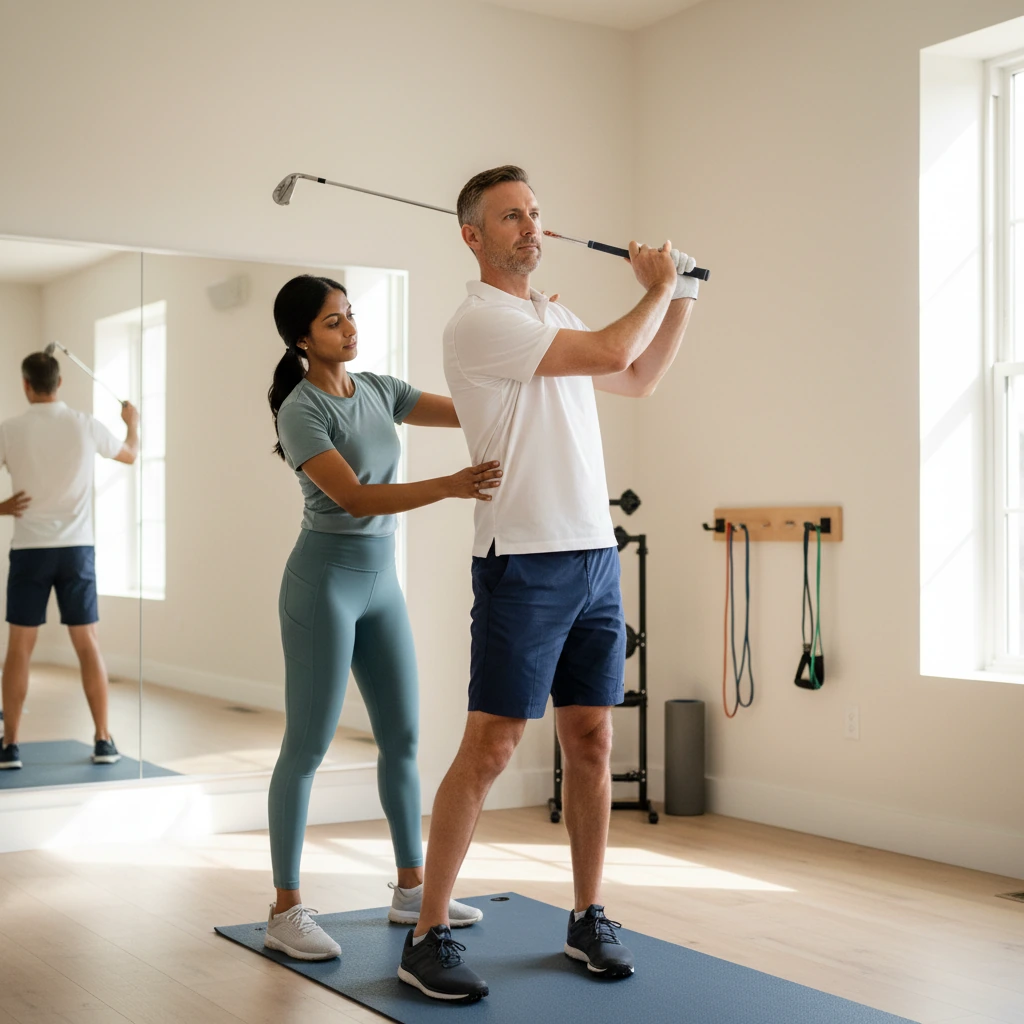
Golf Is More Athletic Than It Looks - and Your Body Is Either Supporting Your Swing or Working Against It
The golf swing generates forces comparable to a football tackle - distributed across nearly every major joint in the body in less than two seconds, repeated hundreds of times over a single round. Most golfers accept pain, stiffness, and inconsistency as inevitable features of the game. They are not. They are consequences of specific physical limitations - restrictions in hip mobility, thoracic rotation, shoulder movement, or core stability - that force compensatory swing mechanics, reduce power output, and accumulate into overuse injury.
At Dynamic Physical Therapy, our Golf Performance Program combines thorough movement assessment with golf-specific rehabilitation and conditioning - identifying the physical restrictions that are limiting your swing efficiency, driving your pain, or putting you at injury risk, and systematically correcting them with one-on-one manual therapy, mobility training, and golf-specific exercise. Whether you're rehabilitating a golf injury, trying to add distance to your drive, or building the physical resilience to play pain-free for years to come - your body is where the work starts.
The Five Physical Demands the Golf Swing Places on Your Body
The golf swing is a kinetic chain movement - power generated from the ground travels through the legs, hips, torso, shoulders, and arms to the club head. When any segment of that chain is restricted or unstable, the segments above and below compensate - altering mechanics, reducing efficiency, and concentrating stress on structures that weren't designed to bear it.
Understanding which physical limitations are affecting your swing is the foundation of everything we do in the golf performance program. A thorough assessment of all five physical domains - not just where you hurt - allows us to identify the root cause of both your pain and your performance limitations.
Thoracic Rotation
The thoracic spine must rotate 45 - 55° in each direction during a full swing. Restricted thoracic mobility is the single most common physical limitation in golfers - forcing the lumbar spine and shoulders to compensate with excessive motion that directly drives low back pain and shoulder impingement.
Hip Mobility & Dissociation
The ability to independently rotate each hip - the lead hip internally rotating while the trail hip externally rotates during the downswing - is essential for generating rotational power without compensating through the lumbar spine. Hip restriction is a primary driver of both low back pain and loss of distance.
Shoulder Mobility & Stability
The lead shoulder must achieve significant internal rotation at address and external rotation at the top of the backswing. The trail shoulder requires adequate external rotation. Restrictions produce the "reverse pivot" or "early extension" swing faults that characterise shoulder-restricted golfers - and directly cause impingement and rotator cuff pathology.
Core Stability & Rotational Power
The core must stabilise the spine during the enormous rotational forces of the swing while simultaneously transmitting power from the lower body to the upper body. Insufficient anti-rotation stability forces the lumbar spine to absorb forces it cannot handle - the mechanism behind the majority of golf-related disc injuries.
Balance & Weight Transfer
Efficient power generation requires weight shift from the trail side at the top of the backswing to the lead side during the downswing and follow-through. Poor balance, limited proprioception, or weakness in the hip stabilisers compromises this transfer - producing a "sway" or "slide" fault that reduces clubhead speed and loads the lumbar spine asymmetrically.
The Five Phases of the Golf Swing - and What Each Demands Physically
Every swing fault, pain pattern, and performance limitation correlates to a specific phase of the swing and a specific physical demand. Understanding this connection is what separates golf-specific physical therapy from generic sports rehabilitation.
Posture, Alignment & Starting Position
The foundation of every swing. Poor posture at address - excessive thoracic kyphosis, forward head position, or asymmetric weight distribution - creates the structural disadvantages that every subsequent phase must compensate for. Physical restrictions that prevent achieving correct posture at address set the entire swing up to fail before the club moves.
Rotation, Coil & Shoulder Turn
The backswing loads the spring - creating the rotational potential energy that the downswing converts to clubhead speed. Inadequate thoracic rotation and restricted shoulder external rotation directly limit the shoulder turn, forcing the arms to "lift" the club rather than rotate it - a loss of both power and accuracy. Hip mobility determines how much of this rotation comes from the correct segment.
Transition, Weight Shift & Power Generation
The most physically demanding phase - generating peak muscle activation and the highest joint loading of the entire swing. The pelvis begins rotating toward the target ahead of the upper body, creating the separation and lag that generates power. Hip internal rotation of the lead hip, core anti-rotation stability, and weight transfer mechanics determine how much of this potential power actually reaches the club head.
Ball Strike - Peak Force Transmission
Impact lasts less than half a millisecond - but the body position at impact determines everything. The lumbar spine at impact is under its highest compressive and shear load. The lead wrist must be in neutral or slight ulnar deviation. The forces transmitted through the hands and wrists at impact are where the majority of elbow, wrist, and hand injuries originate - particularly when impact mechanics place the club on an unintended path.
Deceleration, Finish & Balance
The follow-through decelerates the swing and transfers body weight fully to the lead side - requiring adequate lead hip and ankle mobility to achieve a balanced finish position. Golfers who "fall back" or cannot complete a full follow-through typically have lead hip mobility restrictions or balance deficits that prevent full weight transfer. The follow-through is also where eccentric deceleration loads are highest - a common source of posterior shoulder and elbow pain.
Golf Injuries We Treat - and the Swing Faults That Drive Them
Most golf injuries are not accidents - they are the predictable result of specific physical limitations creating compensatory swing mechanics that concentrate stress on structures not designed to handle it. Treating the injury without addressing the underlying physical restriction leads to the recurring pain pattern that many golfers accept as normal.
Low Back Pain (Most Common Golf Injury)
Driven by insufficient thoracic rotation forcing excessive lumbar rotation and shear loading, and hip restriction redirecting rotation through the lumbar spine. Lumbar disc injuries, facet syndrome, and muscle strain all share these biomechanical drivers - which is why treating the back without addressing the hips and thoracic spine consistently fails.
Golfer's Elbow (Medial Epicondylitis)
Overload of the medial forearm flexors from gripping, wrist ulnar deviation at impact, and the deceleration forces of the follow-through. Often driven by grip tension compensation for poor swing mechanics - when the body is not generating power efficiently, the hands grip harder to compensate.
Rotator Cuff & Shoulder Impingement
Insufficient lead shoulder internal rotation at address and trail shoulder external rotation at the top of the backswing forces the rotator cuff to work in compromised positions - producing impingement, tendinopathy, and eventually tearing with repeated loading across a season of play.
Wrist & Hand Injuries
De Quervain's tenosynovitis, hook of hamate fractures, and wrist tendinopathy from the repetitive loading and impact transmission through the wrist and hand joints - often exacerbated by grip size, grip technique, and impact mechanics that are correctable with intervention.
Hip & Knee Pain
Lead hip labral pathology and knee stress from the rotational and compressive loading of the downswing and follow-through - particularly in golfers with hip mobility restrictions that force abnormal loading patterns on the lead side. Patellofemoral pain and IT band syndrome are common in golfers who walk the course.
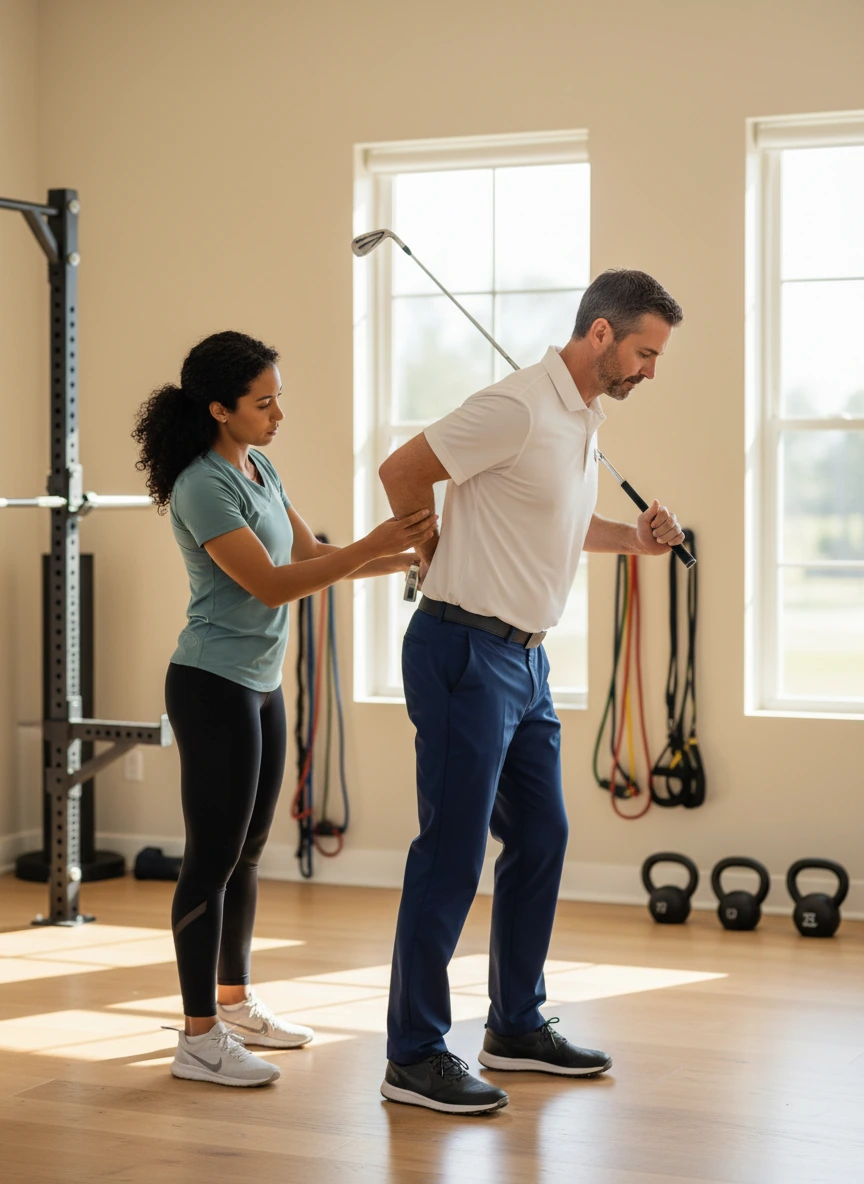
What the Golf Performance Program Includes
A comprehensive, individually designed program addressing your specific physical limitations - not a generic golfer's exercise routine.
Golf-Specific Movement Assessment
A systematic full-body assessment evaluating the five physical domains of the golf swing - thoracic rotation, hip mobility and dissociation, shoulder mobility and stability, core stability and rotational power, and balance and proprioception. Assessment findings directly map to swing faults and injury risk, creating a clear picture of which physical limitations need to be addressed and in what priority order.
Targeted Mobility & Manual Therapy
Joint mobilisation, myofascial release, and specific mobility exercises targeting the restrictions identified in assessment - thoracic extension and rotation, hip internal and external rotation, shoulder posterior capsule stretching, and wrist mobility. Manual therapy produces faster mobility gains than exercise alone, particularly for thoracic and hip restrictions that are the most common performance limitations in golfers.
Golf-Specific Strength & Conditioning
Progressive strengthening targeting the specific muscle groups that generate and stabilise the golf swing - rotational core, hip abductors and external rotators, scapular stabilisers, and forearm/wrist extensors and flexors. Loaded rotation, anti-rotation stability, and hip dissociation patterns are prioritised over general fitness work that doesn't transfer to swing performance.
Rotational Power Development
Medicine ball rotational drills, proprioceptive training with rotational challenges, and SMARTfit cognitive-motor training for the reactive, attention-loaded movement control that competitive and performance golf demands. Power development is introduced once the mobility and stability prerequisites are met - building on the foundation rather than loading dysfunctional patterns.
Injury Rehabilitation & Return to Golf
Phase-based rehabilitation for acute and chronic golf injuries - manual therapy to address the structural pathology, correction of the swing fault or physical limitation that caused it, and progressive return-to-golf loading that rebuilds tolerance before full play resumes. Kinesio Taping for support during the return phase when appropriate.
Season Planning & Injury Prevention
Pre-season assessment and conditioning to identify and address limitations before the season begins, rather than after injury occurs. Maintenance programs for between-season off periods, guidance on warm-up routines before play, and education on practice volume management - the most commonly overlooked driver of golf overuse injuries.
Every Golfer Who Wants to Play Better, Longer, and Pain-Free
Golf performance physical therapy is not reserved for elite players or those with significant injuries. It adds value at every level.
Competitive Golfers
Tournament and club-level players seeking measurable performance gains - increased driving distance, improved swing consistency, and the physical resilience to compete through a full season.
Weekend Golfers
Recreational players who want to play more rounds, walk the course without pain, and enjoy the game for decades - without the back pain, shoulder stiffness, or elbow soreness that cuts seasons short.
Injured Golfers
Players currently managing low back pain, golfer's elbow, shoulder impingement, or wrist injuries - who want to rehabilitate correctly, address the physical cause, and return to full play without recurrence.
Older Golfers
Golfers whose game has declined with age - not because of technique, but because of the mobility losses, balance changes, and strength reductions that targeted physical therapy can meaningfully reverse.
What to Expect from the Golf Performance Program
Golf-Specific Movement Assessment
Your first session is a comprehensive physical evaluation of the five swing-relevant physical domains - not a generic sports physical. Your therapist maps your movement findings to your specific swing faults, pain pattern, or performance goals, establishing exactly which physical restrictions to address and in what order.
Individualised Program Design
A program built specifically for your physical profile - selecting the manual therapy, mobility exercises, strengthening, and conditioning elements most relevant to your restrictions and goals. No generic golf exercise handouts; every element has a specific rationale based on your assessment findings.
One-on-One Treatment Sessions
Every session is dedicated individual time with your licensed therapist - hands-on manual therapy, supervised movement retraining, and progressive exercise that builds toward your performance goals. No shared sessions, no gym-based handoffs. The quality of attention is the same regardless of your skill level.
Home & Course Practice Program
Specific mobility, stability, and warm-up exercises to perform independently - before play, after play, and between sessions. The home program transfers the physical improvements made in clinic to the course, closing the gap between how you move in the PT clinic and how you move when you swing a club.
Reassessment & Long-Term Planning
Physical improvements are objectively reassessed at defined intervals - documenting mobility gains, strength improvements, and the functional changes that translate to swing performance. Long-term maintenance planning keeps you performing and playing through the full season and beyond.
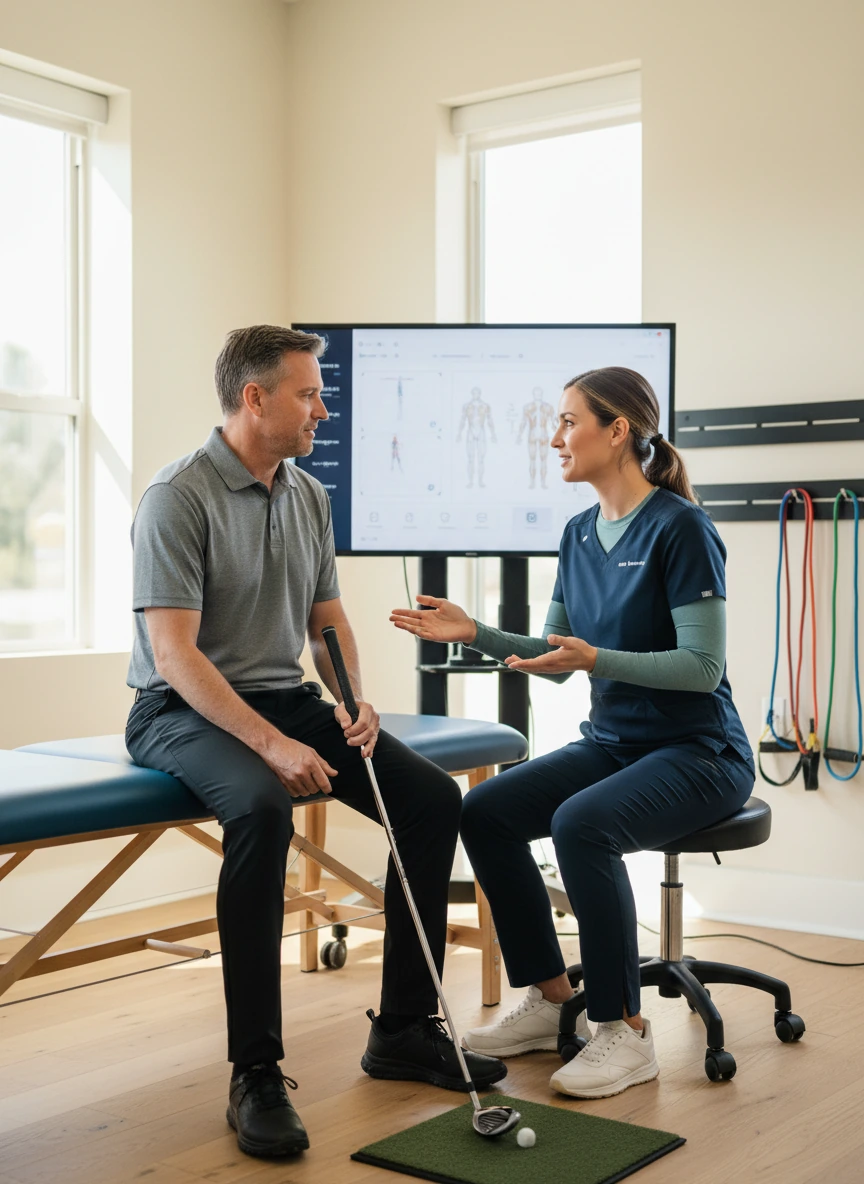
Golf Performance Program FAQs
How is golf physical therapy different from seeing a golf instructor?
A golf instructor can tell you what the swing fault is - the "over-the-top" path, the "reverse pivot," the "early extension." A physical therapist who understands golf biomechanics can tell you why your body is producing that fault - the specific physical restriction or weakness that makes the correct movement biomechanically unavailable to you. Many swing faults are not technique problems; they are physical limitation problems. A golfer with restricted thoracic rotation physically cannot make a full shoulder turn, regardless of how many lessons they take. The most effective approach combines both: the golf instructor addresses technique, and the physical therapist addresses the physical capacity to execute it. At Dynamic PT, we communicate with your golf instructor where possible to ensure both aspects of the correction are aligned.
Can golf PT actually add distance to my drives?
In many cases, yes - because the physical limitations restricting your shoulder turn, hip rotation, or thoracic rotation are directly limiting your ability to generate clubhead speed. Research has demonstrated that improving hip mobility in golfers with restriction produces measurable increases in driving distance - because hip mobility is a primary determinant of pelvis-thorax separation, which is the principal source of clubhead speed in the golf swing. The gains are not from "getting stronger" in a general sense; they come from removing the physical restrictions that are preventing efficient power generation. The same pattern applies to thoracic rotation and shoulder mobility - restrictions that are almost universally present in amateur golfers to some degree, and almost universally undertreated.
I have low back pain every time I play. Is that just part of golf?
No - and accepting it as normal is the most common mistake golfers make. Low back pain during and after golf is the predictable result of specific physical limitations - most commonly restricted thoracic rotation and/or hip mobility - that force the lumbar spine to rotate beyond its safe range on every swing. The lumbar spine is not designed for rotation; it is designed for stability. When the thoracic spine and hips cannot produce the rotation the swing requires, the body takes it from the lumbar spine instead - and the disc and facet pathology that results accumulates with every round. Restoring thoracic and hip mobility typically reduces or eliminates golf-related low back pain without requiring any change to your technique - because the body can now produce the rotation from the correct structures.
Do I need to stop playing golf during the program?
In most cases, no - and we prefer you don't. The goal is to improve your physical capacity so you can play better, not to take you off the course. For golfers managing acute injuries, a short period of rest or modified play (shorter rounds, no driving, practice limitations) may be appropriate for the first 1 - 2 weeks. For performance-focused programs without acute injury, play continues throughout - with specific warm-up and cool-down protocols to protect your improving tissues between sessions. In some cases, playing while improving your mobility actually accelerates the transfer of physical improvements to swing performance, because you're reinforcing the new movement patterns immediately after clinic work.
Is the golf performance program covered by insurance?
When the program addresses a diagnosed musculoskeletal condition - low back pain, golfer's elbow, shoulder impingement, wrist pathology - it is covered by Medicare, Medicaid, and most commercial insurance plans as standard physical therapy. Performance-focused components that are not directly treating a diagnosed condition may be self-pay. At Dynamic Physical Therapy, we structure the program to maximise your insurance benefit for the components that qualify, and we verify your coverage before your first session. Call (718) 826-3200 and our team will walk you through your options.