Queens & Long Island's Premier Physical Therapy | Serving Flushing, Glen Oaks, Hicksville, Massapequa & More
Conditions We Treat

Elbow, Wrist & Hand Pain Relief in Queens & Long Island

Physical therapist performing hand and wrist rehabilitation therapy in Queens

Your Hands Are Central to Everything You Do - Pain Shouldn't Get in the Way

The elbow, wrist, and hand form an interconnected upper extremity chain involving 27 bones in the hand alone, dozens of tendons, multiple peripheral nerves, and a highly complex network of ligaments and joints. These structures work in concert for every grip, lift, type, and gesture you make throughout the day. When any part of this chain is injured, inflamed, or compressed, the impact on your daily function can be immediate and profound.

At Dynamic Physical Therapy, our therapists bring advanced upper extremity training - including EMG/NCS nerve testing and musculoskeletal ultrasound available in-clinic - to ensure your diagnosis is accurate before treatment begins. Every session is one-on-one with a licensed therapist, using hands-on manual therapy, nerve mobilization, targeted strengthening, and ergonomic coaching to restore pain-free function across all six of our Queens & Long Island locations.

Symptoms by Joint - Elbow, Wrist & Hand

Pain in the upper extremity can present very differently depending on which structure is involved. Understanding the distinct symptom patterns of each joint helps guide accurate diagnosis and the most effective treatment.

Elbow Pain

Lateral, medial & posterior elbow symptoms

Outer elbow pain - pain on the lateral epicondyle, worsening when gripping or lifting; the defining feature of lateral epicondylitis (tennis elbow)
Inner elbow pain - tenderness on the medial epicondyle, worse with wrist flexion; classic for golfer's elbow
Elbow stiffness after rest - difficulty fully straightening or bending the elbow, especially in the morning or after sitting still
Numbness into the ring and little fingers - tingling in the ulnar two fingers, characteristic of cubital tunnel syndrome (ulnar nerve compression at the elbow)
Weak grip from elbow pain - difficulty holding objects, turning a doorknob, or shaking hands due to forearm muscle pain originating at the elbow

Wrist Pain

Radial, ulnar & dorsal wrist symptoms

Thumb-side wrist pain - pain at the base of the thumb with pinching or gripping; associated with De Quervain's tenosynovitis or thumb CMC arthritis
Wrist pain with weight-bearing - pain when pushing up from a chair or doing pushups; often indicates TFCC injury or wrist ligament damage
Stiffness and reduced wrist range of motion - inability to fully bend or extend the wrist, often following a fracture or repetitive strain
Swelling over the wrist joint - visible or palpable swelling, sometimes with a bump (ganglion cyst), that increases with activity
Clicking or popping in the wrist - a mechanical sensation with wrist rotation; often related to TFCC tears, ligament instability, or intercarpal pathology

Hand & Finger Pain

Grip, pinch & fine motor symptoms

Nighttime hand tingling - numbness or tingling in the thumb, index, and middle fingers that wakes you at night; the hallmark presentation of carpal tunnel syndrome
Trigger finger or thumb - a finger that locks, clicks, or catches when bending, with pain or tenderness at the base of the affected digit
Swollen, stiff finger joints - joint swelling, warmth, and morning stiffness in the knuckles or PIP joints; characteristic of arthritis or inflammatory conditions
Weak grip or pinch strength - difficulty opening jars, turning keys, or performing fine motor tasks - a common functional complaint in carpal tunnel, arthritis, and nerve injuries
Pain after fracture or surgery - persistent stiffness, weakness, or sensitivity following a distal radius fracture, finger fracture, or tendon repair

Common Elbow, Wrist & Hand Conditions We Treat

Tennis Elbow (Lateral Epicondylitis)

Golfer's Elbow (Medial Epicondylitis)

Carpal Tunnel Syndrome

Cubital Tunnel Syndrome

De Quervain's Tenosynovitis

Trigger Finger & Trigger Thumb

Wrist & Hand Arthritis (OA & RA)

TFCC Tear & Wrist Ligament Injury

Distal Radius & Hand Fracture Rehab

Post-Surgical Hand & Tendon Repair

Ganglion Cyst Pain & Management

Repetitive Strain & Work-Related Injury

How Dynamic PT Treats Elbow, Wrist & Hand Pain

Upper extremity rehabilitation demands precision. We combine hands-on manual therapy, nerve diagnostics, and targeted exercise to restore pain-free grip, fine motor function, and full upper limb mobility.

Manual Therapy & Joint Mobilization

Skilled hands-on mobilization of the elbow, radioulnar, wrist, and small finger joints to restore normal joint mechanics, reduce stiffness, and relieve pain - including specific techniques for tennis elbow, frozen wrist, and post-fracture joint restriction.

Neural Mobilization & Nerve Gliding

Targeted nerve mobilization techniques for the median, ulnar, and radial nerves - relieving the tension, adhesions, and compression that cause carpal tunnel symptoms, cubital tunnel pain, and the tingling that radiates into the fingers.

EMG / NCS & MSKUS Diagnostics

In-clinic EMG/NCS testing to objectively confirm nerve entrapment location and severity, and musculoskeletal ultrasound to visualize tendon pathology, cysts, and soft tissue injuries - ensuring your treatment targets exactly what's causing your symptoms.

Myofascial Release & Trigger Point Therapy

Deep tissue work targeting the forearm flexors and extensors, pronator teres, and intrinsic hand muscles - releasing the fascial restrictions and trigger points that perpetuate lateral epicondylitis, medial epicondylitis, and chronic forearm pain.

Grip Strength & Functional Rehabilitation

Progressive strengthening and fine motor rehabilitation targeting grip, pinch, and wrist stability - restoring the functional strength needed to return to your specific work, sport, or daily activities with full confidence and no pain.

Ergonomic Education & Activity Modification

Practical guidance on keyboard and mouse positioning, tool grip technique, sleeping positions, and repetitive task modification - addressing the daily habits and ergonomic drivers that caused or are perpetuating your upper extremity pain.

What to Expect from Your First Visit

1

Full Upper Extremity Evaluation

Your therapist evaluates the entire upper limb - shoulder, elbow, forearm, wrist, and hand - including nerve tension tests, grip strength measurement, joint mobility, and sensory screening to map the full clinical picture.

2

In-Clinic Nerve & Imaging Diagnostics

If nerve involvement is suspected, EMG/NCS testing can be performed in-clinic to confirm which nerve is affected and where. MSKUS imaging is available to visualize tendon and soft tissue pathology in real time.

3

One-on-One Hands-On Treatment

Every session is dedicated, individual time with your licensed therapist. Treatment is specific to your diagnosis - not a generic hand PT protocol - and progressed carefully based on your tissue response at each visit.

4

Home Program & Ergonomic Coaching

You'll receive targeted exercises and clear ergonomic adjustments to implement at home and work - including specific advice on tool use, typing posture, and sleeping positions that could be aggravating your condition.

5

Return to Full Function

Discharge happens when your grip strength, range of motion, and functional performance meet your specific goals - whether that's returning to an instrument, a trade, a sport, or simply being able to open a jar without pain.
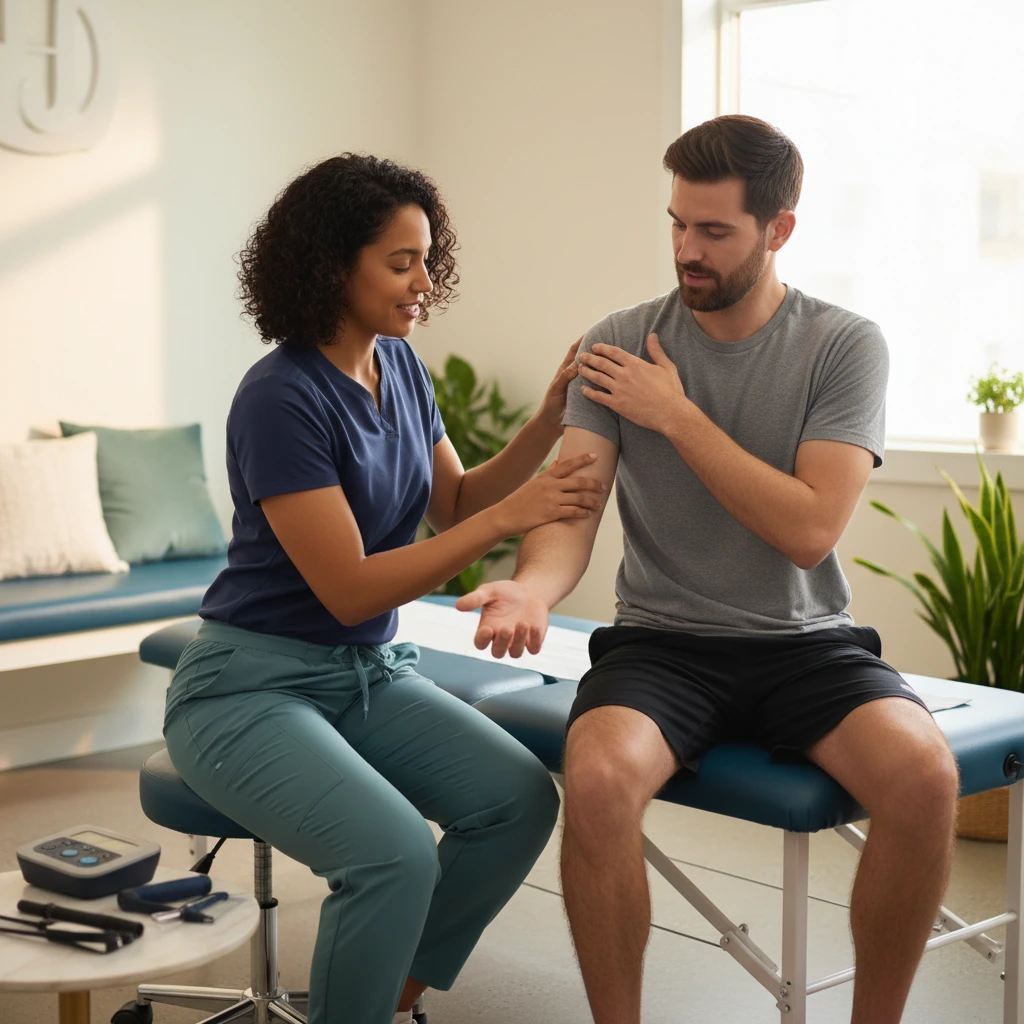
Physical therapist performing hand therapy and wrist rehabilitation at Dynamic Physical Therapy in Queens

Benefits of PT for Elbow, Wrist & Hand Pain

Avoid Injections & Surgery

Most upper extremity conditions - including carpal tunnel, tennis elbow, and trigger finger - resolve with conservative PT, avoiding the risks, recovery time, and costs of cortisone injections and surgical procedures.

Restore Grip & Fine Motor Function

Regain the ability to type, grip tools, play instruments, cook, and perform the fine motor tasks that pain has been limiting - with functional strength that holds up throughout your full work day.

Sleep Without Tingling

Carpal tunnel and cubital tunnel symptoms peak at night. Nerve mobilization and targeted home positioning advice directly address the nighttime tingling and numbness that disrupts sleep.

Return to Work & Sport

Whether you're a healthcare worker, tradesperson, office worker, or athlete, we design your recovery around the specific physical demands of your work and sport - not just generic functional milestones.

Elbow, Wrist & Hand Pain FAQs

Can physical therapy cure carpal tunnel without surgery?

For mild to moderate carpal tunnel syndrome, physical therapy - particularly nerve gliding exercises, manual therapy, and ergonomic modification - is a well-supported conservative treatment that can fully resolve symptoms in many patients. Surgery is generally considered when conservative care fails after a sustained trial, or when there is significant nerve damage confirmed on EMG/NCS testing. At Dynamic PT, we perform EMG/NCS in-clinic to objectively confirm the severity of your carpal tunnel before recommending a treatment path - ensuring you don't undergo surgery unnecessarily, or alternatively, don't delay it when it's genuinely needed.

I have tennis elbow but don't play tennis. Can I still develop it?

Absolutely - the majority of tennis elbow cases actually occur in people who have never played tennis. Lateral epicondylitis is caused by repetitive loading of the extensor carpi radialis brevis tendon, which occurs with any activity requiring repeated gripping, lifting, or forearm rotation - including typing, carpentry, plumbing, painting, and manual labor. The condition is extremely common in people aged 40 - 60 who use their hands repetitively at work. Physical therapy is the most effective first-line treatment, with most patients achieving full resolution within 6 - 12 weeks.

How long does recovery from a wrist fracture take with physical therapy?

After immobilization is removed - typically 4 - 8 weeks post-fracture depending on the type - PT begins with gentle range of motion and swelling management, progressing to strengthening and functional retraining. Total recovery to full pain-free function typically takes 3 - 6 months for a distal radius fracture, though most patients regain independence with daily activities much sooner. Post-surgical wrist fractures (ORIF) follow a similar timeline coordinated directly with your surgeon. Starting PT promptly after cast removal is critical to preventing the joint stiffness and muscle atrophy that accumulate during immobilization.

What is cubital tunnel syndrome and how is it treated?

Cubital tunnel syndrome is compression of the ulnar nerve at the elbow - the equivalent of carpal tunnel for the "funny bone" nerve. It causes tingling and numbness in the ring and little fingers, inner elbow pain, and in more severe cases, weakness of the intrinsic hand muscles. It's often aggravated by prolonged elbow flexion (talking on the phone, sleeping with the elbow bent). Conservative treatment with PT - nerve gliding, activity modification, elbow padding advice, and addressing any posture contributors - resolves many cases. For confirmed nerve damage on EMG testing, or cases that don't respond to conservative care, surgical transposition may be considered.

Can trigger finger be treated without a cortisone shot or surgery?

Yes - in many cases, particularly mild to moderate trigger finger, physical therapy with manual therapy, specific tendon gliding exercises, and activity modification can resolve locking and pain without injections or surgery. Splinting during the acute phase and modifying gripping activities that aggravate the A1 pulley are often the most effective early interventions. For more advanced or recurrent cases, cortisone injection is a reasonable adjunct, but PT before and after the injection significantly improves the durability of the result. Our therapists will assess the severity of your trigger finger and give you an honest recommendation on the most appropriate treatment pathway.

Is elbow, wrist, and hand PT covered by insurance?

Physical therapy for upper extremity conditions is covered by most major insurance plans, including Medicare, Medicaid, Workers' Compensation, No-Fault, and commercial insurers - particularly for work-related repetitive strain injuries and post-surgical rehabilitation. At Dynamic Physical Therapy, we verify your complete benefits before your first appointment so you know exactly what is covered. Call us at (718) 826-3200 and our team will confirm your coverage in advance.
Therapist helping a patient during a physical therapy session

Ready to Get Started? Schedule Your Visit Today.

Whether you're dealing with chronic pain, recovering from surgery, or managing a new injury, our team is ready to help. We offer complimentary assessments at all six of our locations across Queens and Long Island. A licensed therapist will review your symptoms, perform a movement screen, and give you a clear direction at no cost and with no pressure.