Hand Therapy in Queens & Long Island

The Most Intricate Structures in the Body Require the Most Specialised Rehabilitation
Your hands perform over 1,700 distinct tasks per day - from typing and gripping to the finest precision movements of dexterity. No other region of the body concentrates this density of functional demand into so small a structure. Injuries, surgical repairs, and chronic conditions affecting the hand, wrist, and upper extremity require a level of anatomical precision, protocol knowledge, and rehabilitation skill that makes hand therapy a distinct specialty within physical therapy.
At Dynamic Physical Therapy, hand therapy is delivered by therapists with advanced training in upper extremity rehabilitation - bringing specialised expertise in tendon, nerve, fracture, and soft tissue management from the shoulder through the fingertips. Whether you are recovering from hand surgery, managing chronic wrist pain, or rehabilitating a nerve injury, your program is built from the specific protocols, timelines, and techniques that the anatomy of your injury demands.
The Hand's Anatomy Demands More Than Standard Physical Therapy Can Provide
The hand is the most anatomically complex region in the musculoskeletal system - packing more joints, tendons, nerves, and blood vessels per cubic centimetre than any other structure in the body. This density means that even small injuries produce disproportionate functional loss, and that rehabilitation errors - wrong timing, wrong force, wrong positioning - produce complications including tendon rupture, joint contracture, and permanent stiffness that are very difficult to correct once established.
Hand therapy is effective precisely because it is protocol-driven in ways that standard PT is not - the timing of mobilization after flexor tendon repair, the specific range limits for zone-specific tendon protocols, the positioning requirements for nerve repair splinting, the forces required for dynamic versus static splinting - these are not generic rehabilitation principles. They are subspecialty knowledge that determines whether a complex upper extremity repair heals with full function or with a preventable complication.
Tendon Anatomy & Zone-Specific Protocols
The flexor and extensor tendons are divided into anatomical zones, each with different tissue density, blood supply, and healing characteristics - requiring zone-specific rehabilitation protocols. The timing, force, and range of mobilization after tendon repair is dictated by zone, surgical technique, and repair strength.
Nerve Anatomy & Sensory Re-Education
The hand contains the densest concentration of sensory receptors in the body. Nerve injuries - lacerations, compressions, stretch injuries - require sensory re-education protocols that retrain the brain's cortical representation of hand sensation as nerve regeneration proceeds.
Scar Tissue & Edema Management
Post-surgical and post-traumatic scarring within the confined anatomical compartments of the hand rapidly produces tendon adhesion, joint contracture, and functional loss that is far harder to reverse once established. Early, precisely timed scar management and edema control are essential to preventing these complications.
Custom Splinting & Orthotics
Thermoplastic custom splints - fabricated from heated malleable material moulded directly to the patient's hand - are a unique hand therapy deliverable. Static, static-progressive, and dynamic splints protect repairs, prevent contracture, correct deformity, and position the hand for optimal healing in ways that off-the-shelf bracing cannot achieve.
Symptoms and Situations That Warrant Specialist Hand Rehabilitation
Many hand and upper extremity conditions are undertreated or managed with generic PT that lacks the protocol specificity that hand injuries require. These are the presentations that benefit most from specialist hand therapy.

Hand, Wrist & Upper Extremity Conditions Treated at Dynamic PT
Hand & Wrist Fractures
Flexor & Extensor Tendon Repairs
Carpal Tunnel Syndrome
Trigger Finger (Stenosing Tenosynovitis)
De Quervain's Tenosynovitis
Peripheral Nerve Injuries & Repairs
Lateral & Medial Epicondylalgia
Dupuytren's Contracture Rehab
Post-Surgical Scar Management
Burns & Skin Grafts (Upper Extremity)
TFCC Injuries & Wrist Instability
CMC Arthritis & Basal Joint Pain
Mallet Finger & Jersey Finger
Work-Related Upper Extremity Injuries
Cubital Tunnel & Ulnar Nerve Entrapment
Lymphedema & Post-Surgical Edema
The Four Stages of Hand & Upper Extremity Post-Surgical Rehabilitation
Post-surgical hand rehabilitation is more protocol-driven than almost any other area of PT - because the window for intervention at each stage is narrow, and errors in timing or force produce complications that are difficult or impossible to reverse. These four stages apply across most hand surgical procedures, with specific protocol variations by surgery type.
Protective Phase - Edema Control & Wound Management
The immediate post-operative period focuses on controlling swelling, managing the wound, and positioning the hand in the correct protective posture. Custom thermoplastic splinting is fabricated within the first 24 - 72 hours - holding repaired structures in the position that minimises tension while maintaining the tissue length that subsequent rehabilitation requires. Edema management is critical in this phase because chronic edema rapidly converts to fibrotic restriction.
Early Active Phase - Controlled Motion Within Safe Limits
The most critical and technically demanding phase - introducing controlled motion to prevent adhesion formation within the strict range limits that protect the surgical repair. For flexor tendon repairs, zone-specific protocols dictate precise excursion limits. For fractures, motion is introduced based on radiographic healing confirmation. Early controlled motion is the intervention most responsible for preventing the joint contracture and tendon adhesion that produce permanent functional loss.
Intermediate Phase - Progressive Loading & Strength Development
As tissue healing progresses, rehabilitation advances toward full active range of motion and the introduction of progressive resistive exercise. Scar mobilization becomes more aggressive, static-progressive splinting addresses any residual stiffness or extension lag, and the focus shifts from motion restoration to grip and pinch strength development. Sensory re-education begins for nerve repairs as regenerating fibres reach the hand.
Functional Return Phase - Work Hardening & Activity-Specific Training
The final phase progresses from clinic-based exercises to the actual functional demands of work, sport, and daily life. Work-hardening programs build the grip strength, endurance, and coordination for occupational demands. Sport-specific upper extremity conditioning prepares for return to throwing, racquet sports, or grip-intensive activities. Joint protection education reduces the risk of re-injury or overuse as the hand returns to full loading.
What Hand Therapy at Dynamic PT Includes
A comprehensive range of specialised techniques - selected based on your specific injury, surgical procedure, and rehabilitation stage.
Manual Therapy & Joint Mobilization
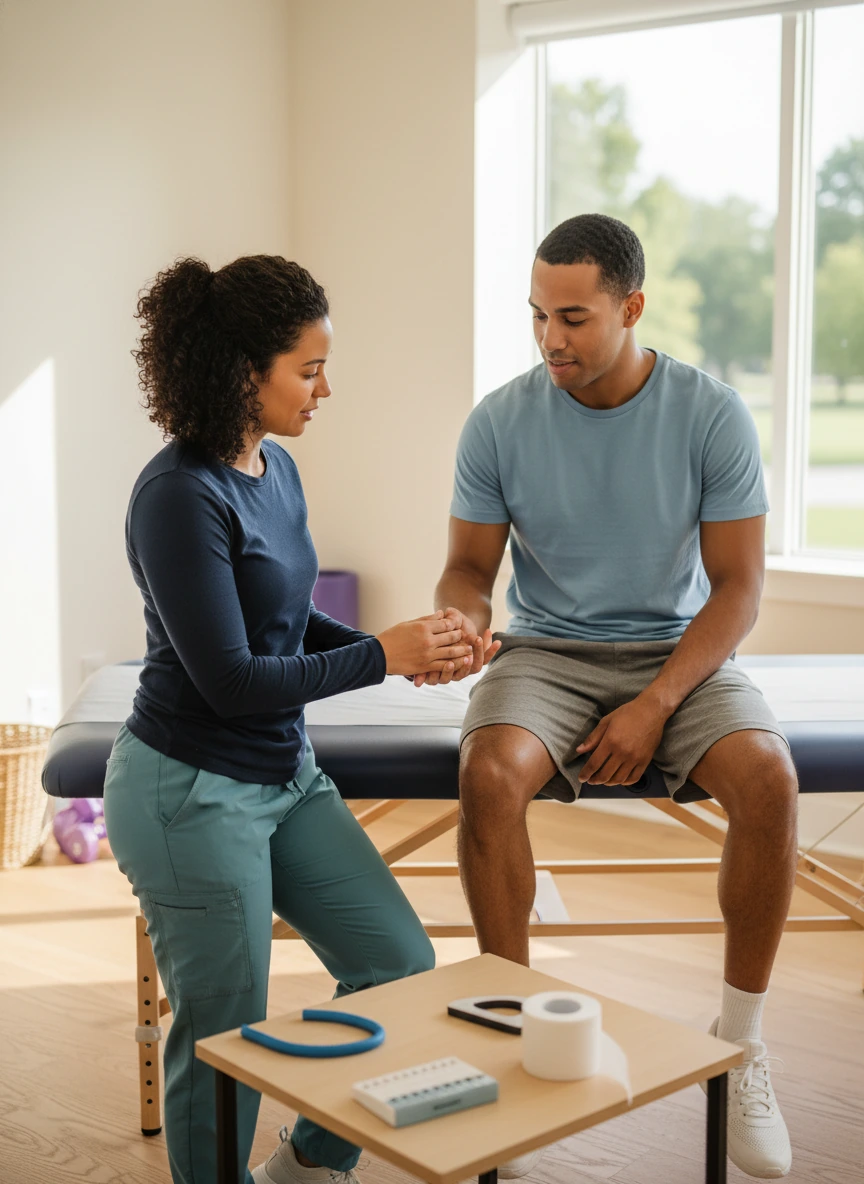
Skilled passive joint mobilization of the carpals, MCPs, PIPs, DIPs, and thumb joints - restoring the arthrokinematic accessory movement that immobilization rapidly eliminates. Manual scar tissue mobilization and myofascial release for the dense adhesive restrictions that post-surgical and post-traumatic scarring produces within the confined fascial compartments of the hand.
Edema Management
Retrograde massage, compression garments, coban wrapping, and Kinesio lymphatic taping applied systematically to control post-surgical and post-traumatic edema - reducing the swelling that both restricts motion directly and, if chronic, converts to fibrotic tissue that is far harder to treat than the original injury.
Scar Management
Direct scar tissue mobilization, silicone gel sheeting, compression, and specific massage techniques targeting post-surgical and post-traumatic scars - preventing hypertrophic scar formation, releasing the adhesions between scar and underlying tendon/capsule, and restoring the skin mobility that free joint and tendon movement requires.
Tendon Gliding & Neural Mobilization
Specific tendon gliding exercise sequences that produce maximum differential excursion between the flexor tendons and surrounding tissue - preventing tendon adhesion after repair or fracture. Neural gliding exercises for the median, ulnar, and radial nerve in the upper extremity following nerve repair, carpal tunnel release, or compression syndromes.
Sensory Re-Education
Systematic sensory retraining programs that retrain the brain's cortical representation of hand sensation as peripheral nerves regenerate - progressing from moving touch and vibration discrimination to static touch, texture discrimination, and object recognition. Essential for restoring functional hand use after nerve repair or severe compression syndromes.
What to Expect from Hand Therapy at Dynamic PT
Comprehensive Upper Extremity Assessment
A thorough evaluation of range of motion (active and passive), grip and pinch strength, sensation (two-point discrimination, Semmes-Weinstein monofilament testing), edema, scar quality, functional dexterity, and pain - establishing the objective baseline against which all progress is measured and the treatment plan is built.
Surgeon Coordination for Post-Surgical Cases
For post-surgical patients, your therapist reviews the operative report, contacts the surgeon for protocol clarification where needed, and confirms the specific range limits, mobilization timing, and loading restrictions that the procedure requires. This direct surgeon-therapist communication is essential to safe post-surgical rehabilitation.
Splint Fabrication (Where Indicated)
Custom thermoplastic splints are fabricated in-clinic for post-surgical patients, fractures, tendon injuries, and conditions requiring specific joint positioning. The splint is moulded directly to your hand for exact fit - and modified as your hand changes through the rehabilitation stages.
Stage-Appropriate Hands-On Treatment
Every session includes direct hands-on treatment - manual therapy, edema management, scar mobilization, or exercise - calibrated to your current healing stage and objective assessment findings. Hand therapy sessions are typically more frequent in the early stages (2 - 3 per week) and reduce in frequency as you progress toward independence.
Progressive Home Program
A detailed home exercise program is provided from the first session - specific tendon gliding sequences, ROM exercises, edema management techniques, and sensory re-education - with clear instructions on frequency, range limits, and what to watch for that indicates the program needs to be modified.
What Specialist Hand Therapy Prevents - and Standard PT May Not
Prevents Tendon Adhesion
Correctly timed early mobilization - in the specific range that protects the repair while preventing adhesion - is the single most important intervention in flexor tendon rehabilitation. Delayed or insufficiently specific mobilization produces adhesion that requires re-operation to correct.
Prevents Joint Contracture
The hand's joint capsules and collateral ligaments shorten rapidly with immobilization. Protocol-driven early motion and precise splinting prevent the contractures that, once established, require months of intensive stretching or surgical release to correct.
Restores Dexterity & Function
The goal of hand therapy is not just pain-free range of motion - it is the restoration of the fine motor coordination, sensory precision, grip strength, and functional dexterity that make hands useful for the specific activities that matter to each patient.
Return to Work & Daily Life
Work hardening and occupation-specific rehabilitation ensure that the hand is physically capable of the actual demands of the patient's job and daily life - not just performing well in the clinic under controlled conditions.
Hand Therapy FAQs
How soon after hand surgery should I start hand therapy?
For most hand surgeries, hand therapy should begin within 24 - 72 hours of the procedure - starting with custom splint fabrication, edema management, and wound care even before any exercises are introduced. For flexor tendon repairs, early controlled motion begins within the first 3 - 5 days depending on the protocol. Delaying the start of hand therapy beyond the first week after surgery significantly increases the risk of tendon adhesion, joint contracture, and scar complications that are progressively harder to prevent the later they develop. If your surgeon has not arranged hand therapy referral, contact us directly - we can communicate with your surgeon to confirm the appropriate protocol before your first session.
Why do I need a custom splint - can't I use a pre-made brace?
For many acute hand and wrist conditions, off-the-shelf bracing is entirely appropriate. For post-surgical cases, complex injuries, and situations requiring exact joint positioning - custom thermoplastic splinting is a clinical necessity, not a preference. The required wrist angle, finger position, and IP joint flexion or extension that a post-surgical protocol specifies cannot be reliably achieved with a pre-made brace designed for an average hand anatomy. A dynamic splint that assists finger extension after extensor tendon repair requires tension calibration that is impossible in a pre-made device. The clinical risk of incorrect positioning in post-surgical cases - ruptured repair, adhesion, or contracture - makes custom splinting the standard of care for complex upper extremity rehabilitation.
I have trigger finger. Can hand therapy help without surgery?
Yes - for mild to moderate trigger finger, conservative hand therapy produces complete resolution in a significant proportion of patients. Treatment includes night-time extension splinting to prevent the flexed position in which the nodule catches on the annular pulley, manual therapy to the flexor tendon sheath, specific tendon gliding exercises that promote differential movement of the tendon through the pulley, and activity modification. Splinting alone for 6 weeks produces resolution in approximately 55 - 70% of patients. If conservative management does not produce adequate improvement, corticosteroid injection and surgical release remain options - hand therapy is not a substitute for these when indicated, but it is the appropriate first-line intervention before pursuing more invasive treatment.
How long does hand therapy take?
Duration varies significantly by condition. For straightforward conditions like De Quervain's tenosynovitis or mild carpal tunnel syndrome, 6 - 10 sessions over 4 - 6 weeks is typical. For complex post-surgical rehabilitation after flexor tendon repair or nerve repair, a full rehabilitation course is 3 - 4 months of frequent sessions. Fracture rehabilitation typically runs 6 - 12 weeks depending on the fracture location and fixation method. The most important factor is not the number of sessions, but that they occur at the right frequency at the right stage - intensive early rehabilitation that protects the repair is more important than a prolonged lower-intensity course later.
Is hand therapy covered by insurance?
Hand therapy delivered by a physical therapist is covered by Medicare, Medicaid, Workers' Compensation, No-Fault, and most commercial insurance plans when medically necessary - billed as physical therapy services. Custom splint fabrication is typically covered as a separate orthotics benefit. Workers' Compensation covers hand therapy for work-related upper extremity injuries including repetitive strain, crush injuries, and post-surgical rehabilitation. At Dynamic Physical Therapy, we verify your complete benefits before your first appointment and handle all insurance coordination, including No-Fault documentation for motor vehicle accident hand injuries. Call (516) 661-9880 to confirm your coverage.