EMG & Nerve Conduction Studies in Queens & Long Island
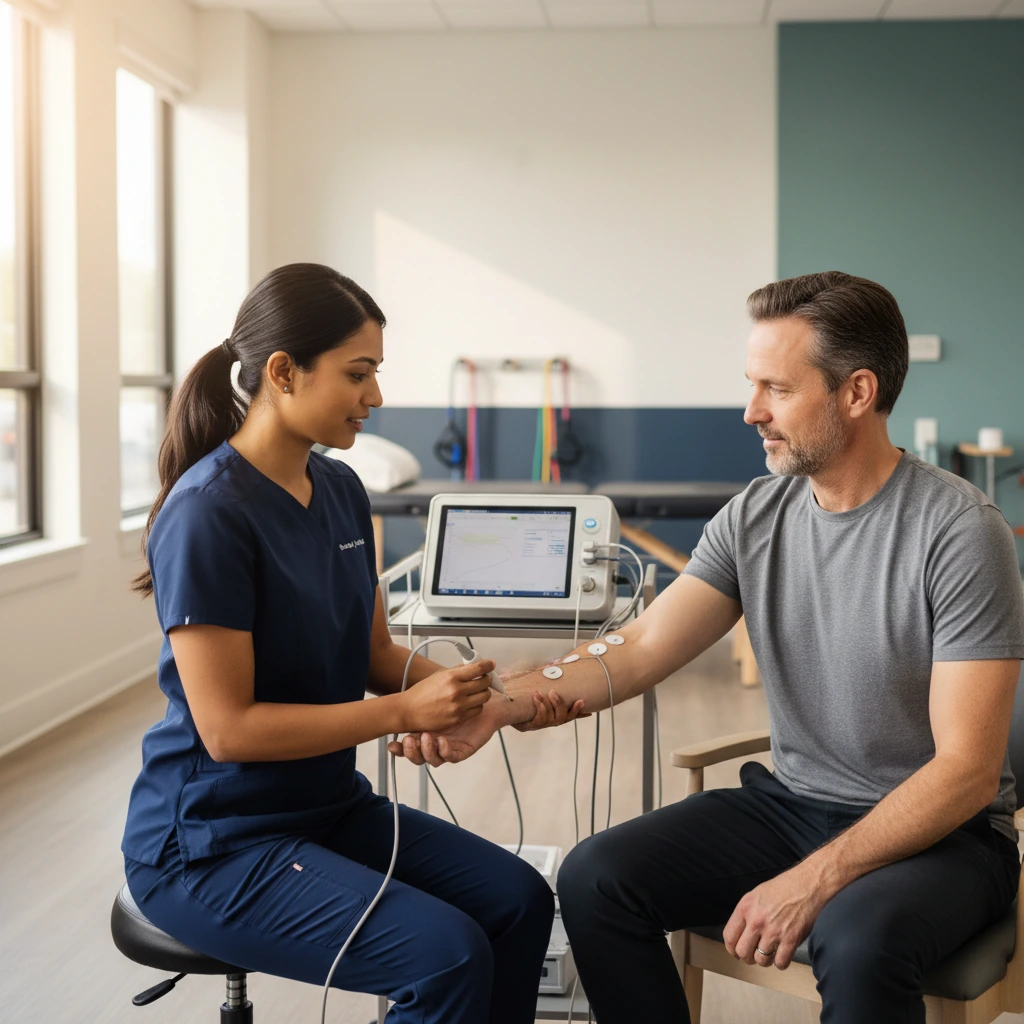
The Definitive Test for Nerve and Muscle Conditions — Available In Our Clinic with Fast Scheduling
Electromyography (EMG) and Nerve Conduction Studies (NCS) are the gold-standard electrodiagnostic tests for assessing the health and function of your peripheral nervous system and the muscles it controls. When you have numbness, tingling, burning pain, weakness, or radiating symptoms that a physical examination alone cannot definitively explain, an EMG/NCS study provides the precise, objective data that confirms or changes the diagnosis — and guides the treatment decisions that follow.
At Dynamic Physical Therapy, EMG and nerve conduction testing is performed in-clinic by our trained clinical team — not sent to an external neurology lab with a separate referral, a separate appointment, and weeks of waiting. Your study can typically be scheduled within days, the findings are reviewed promptly, and the results are integrated into your physical therapy plan by the therapist who already understands your presentation. That direct clinical handoff is the advantage of having electrodiagnostic capability within a PT practice.
Why In-Clinic EMG/NCS Changes Your Care
Research shows that approximately 50% of initial diagnoses change after an EMG/NCS evaluation is performed. In the conventional pathway, a patient with nerve pain waits weeks for a neurology referral, undergoes testing, waits for results, then waits again for a PT referral based on the updated diagnosis. At Dynamic PT, we shorten that delay dramatically by coordinating the study in-house, reviewing findings quickly, and folding the results into your care plan without the usual back-and-forth. Earlier correct diagnosis means earlier correct treatment, and earlier correct treatment means faster recovery.
EMG and NCS — Two Distinct Tests That Answer Different Clinical Questions
EMG and NCS are almost always performed together in the same session — but they test different aspects of neuromuscular function and provide different diagnostic information.
Nerve Conduction Study (NCS)
Measures how fast and how strong electrical signals travel along a nerve — identifying damage to the nerve itself, its myelin sheath, or its axon, and determining where along the nerve's course the damage is located.
Electromyography (EMG)
Measures the electrical activity produced by muscle fibres — at rest and during voluntary contraction — to determine whether the muscle is responding normally to nerve signals and whether muscle disease is independently present.
Symptoms That Should Prompt Electrodiagnostic Testing
EMG and NCS are the appropriate next step when nerve or muscle pathology is suspected but cannot be definitively confirmed by clinical examination alone — which includes a large proportion of patients presenting with arm, leg, and spinal pain.

Nerve & Muscle Conditions Confirmed by EMG/NCS at Dynamic PT
Carpal Tunnel Syndrome
Cervical Radiculopathy
Lumbar Radiculopathy & Sciatica
Thoracic Outlet Syndrome
Cubital Tunnel (Ulnar Nerve)
Radial Nerve Entrapment
Peripheral Neuropathy
Diabetic Neuropathy
Tarsal Tunnel Syndrome
Brachial Plexopathy
Peroneal Nerve Palsy (Foot Drop)
Myopathy & Muscle Disease
What EMG/NCS Results Tell Your Clinician — and Why They Change Treatment
The data generated by an EMG/NCS study provides objective, quantifiable information about the health of your nerve and muscle — information that no clinical examination, imaging study, or symptom description can replicate. Four specific dimensions of nerve and muscle health are assessed.
These findings directly determine treatment decisions: whether conservative PT is appropriate, which techniques are most indicated, whether surgical referral is needed urgently, and what the realistic prognosis is. Without this data, treatment is guided by inference. With it, treatment is guided by objective evidence.
Conduction Velocity — How Fast
Slowed conduction velocity indicates myelin sheath damage (demyelination) — the insulation around the nerve has been compromised. This is the hallmark finding in carpal tunnel syndrome and early neuropathy, and has a good prognosis for recovery with appropriate treatment.
Amplitude — How Strong
Reduced signal amplitude indicates axonal loss — the nerve fibres themselves are damaged or lost. Axonal injury has a much longer recovery timeline than demyelination, and severe axonal loss may indicate that urgent surgical intervention is needed before the window for nerve regeneration closes.
Distribution — Where
By testing multiple nerves and muscles, the study precisely localises the lesion — distinguishing a root lesion from a peripheral nerve lesion, plexus lesion, or diffuse polyneuropathy. This localisation directly determines whether conservative PT, injection, or surgery is the appropriate pathway.
Chronicity — How Long
EMG findings distinguish acute denervation (fibrillation potentials — recent nerve-muscle disconnection) from reinnervation (polyphasic potentials — nerve is growing back) from chronic stable denervation (no regeneration occurring). This chronicity data guides the urgency of intervention and prognosis.
What to Expect During Your EMG/NCS Study at Dynamic PT
Preparation Before You Arrive
Do not apply lotion, cream, or oil to your skin on the day of testing — skin conductivity is essential for accurate NCS electrode contact. Dress in loose clothing that allows access to your arms or legs. No fasting is required. Inform us in advance if you take blood thinners, have a pacemaker or implanted defibrillator, or have a known bleeding disorder.
Nerve Conduction Study (NCS) — First
Surface electrode patches are applied to your skin over the nerves being tested. A small electrical stimulus is delivered at one site and the response recorded at another. The sensation is a brief tingle or mild electric shock — similar to a static electricity discharge. Several nerves are tested, each at multiple points. This component is completely non-invasive.
Electromyography (EMG) — Second
A fine, sterile needle electrode is inserted into each muscle being assessed. You will be asked to relax completely, then gently contract, then contract more strongly. The electrical activity from these manoeuvres is displayed on a screen and recorded. Most patients find the discomfort significantly less than expected. Brief muscle soreness for 24–48 hours is normal.
Total Testing Time: 30–90 Minutes
The complete study takes 30–90 minutes depending on how many nerves and muscles need to be assessed. A focused CTS evaluation is at the shorter end; a comprehensive work-up of an unclear neuropathy with multiple limb involvement takes longer.
Results, Discussion & Treatment Integration
Your results are reviewed with you immediately following the study — explaining what was found, what it means for your diagnosis, and how it changes or confirms your treatment plan. A written report is generated for your physician. Because the test is performed within your PT visit, the findings are immediately integrated into your rehabilitation program.
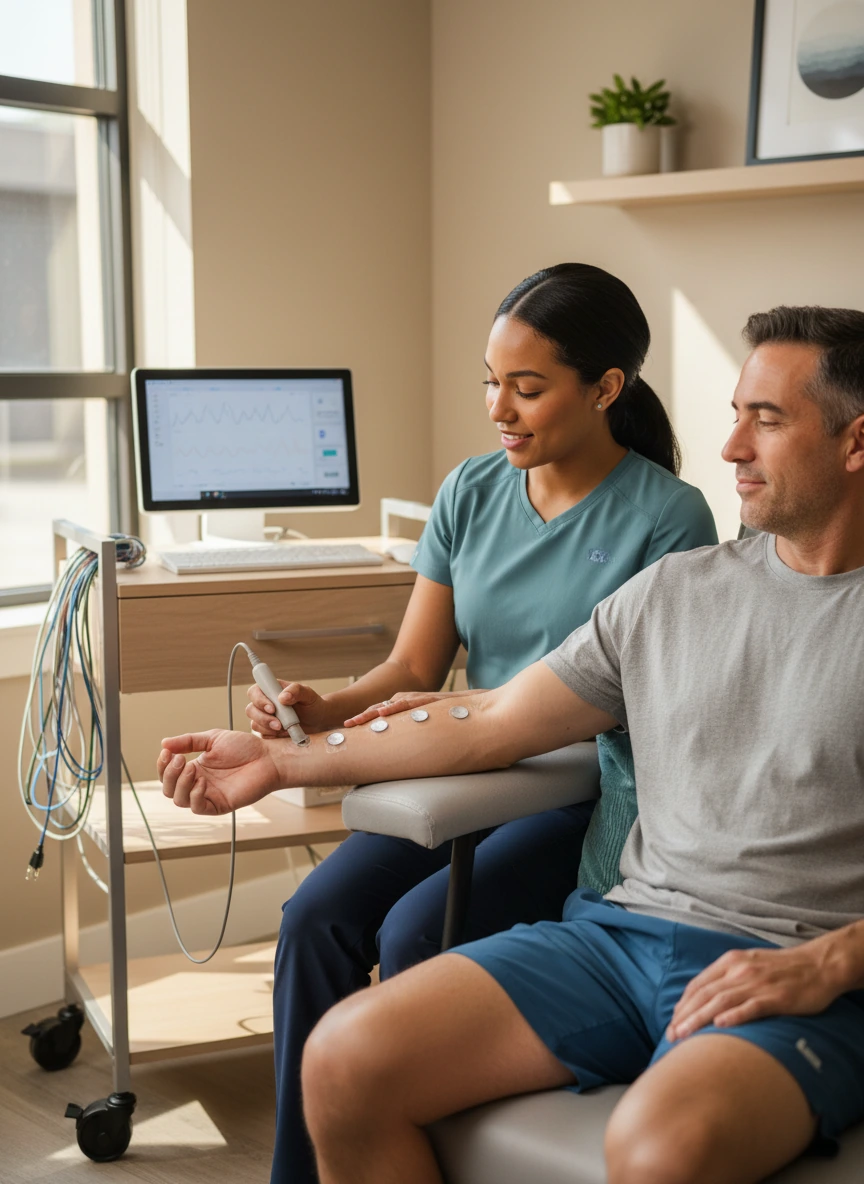
Why In-Clinic EMG/NCS at Dynamic PT Accelerates Your Recovery
Confirms the Correct Diagnosis
Up to 50% of initial diagnoses change after EMG/NCS testing. Getting the diagnosis right before committing to a treatment course prevents weeks of misdirected treatment — the most common reason nerve pain presentations fail to respond to conservative care.
Faster Scheduling, Faster Answers
No separate neurology referral and no extended outside-lab wait. Your testing is coordinated quickly in our clinic, and the findings are reviewed promptly so your treatment plan can move forward with less delay.
Objective Severity Grading
EMG/NCS provides quantifiable severity data — mild, moderate, or severe — that clinical examination cannot. This grading determines the realistic prognosis, the urgency of intervention, and whether conservative management or surgical referral is appropriate.
Treatment Response Monitoring
Repeat NCS after a course of conservative treatment objectively measures whether the nerve is recovering, stable, or deteriorating — providing the data needed to determine whether the current treatment is sufficient or escalation is required.
EMG & NCS FAQs
Is the needle EMG painful?
The needle component of EMG is consistently less uncomfortable than patients expect. The needle used is a fine, sterile, single-use electrode approximately the diameter of an acupuncture needle — much finer than a hypodermic needle. The insertion feels like a brief, mild prick at the skin surface. Within the muscle, you may feel a dull ache when contracting, and occasionally a brief twitch when the needle repositions. Most patients report that the NCS electrical stimulation is more uncomfortable than the needle, and that the overall test was significantly less unpleasant than anticipated. Muscle soreness for 24–48 hours afterward is normal — the same minor ache as after deep tissue massage.
How is EMG/NCS different from an MRI for diagnosing nerve pain?
MRI and EMG/NCS provide complementary but fundamentally different information. MRI shows anatomy — disc herniation, spinal stenosis, nerve root compression. What MRI cannot show is whether that structural abnormality is actually causing a functional problem with the nerve, or how severe that functional impairment is. EMG/NCS shows physiology — how the nerve is actually functioning, the severity of any compromise, and the exact distribution of the problem. Many patients have disc herniations on MRI that are not causing any nerve dysfunction; others have severe radiculopathy with entirely normal MRI. EMG/NCS fills the gap between what imaging shows structurally and what is happening functionally — which is why the two tests are complementary, not interchangeable.
I have a pacemaker — can I still have EMG/NCS testing?
In most cases, yes — with appropriate precautions. Pacemakers and implanted defibrillators are a relative contraindication to EMG/NCS, not an absolute one. The needle EMG component involves no electrical stimulation and is generally safe. The NCS component uses small surface electrical stimuli that need to be applied carefully — typically with the stimulating electrode at distance from the pacemaker. Inform us at your initial consultation that you have a pacemaker or implanted device, and we will assess the most appropriate approach for your specific situation and device type.
How do I prepare for my EMG/NCS appointment?
The main preparation requirement is skin: do not apply lotion, cream, moisturiser, or oil to your arms or legs on the day of testing — skin surface products reduce the conductivity needed for accurate NCS electrode contact. Wear loose clothing that allows easy access to your arms or legs without needing to fully undress. No fasting is required. Continue all medications as normal unless specifically instructed otherwise. Bring a list of current medications. If you take anticoagulants (blood thinners), inform us — the needle component is still generally safe but we note it in advance.
Is EMG/NCS testing covered by insurance?
EMG and nerve conduction studies are covered by Medicare, Medicaid, Workers' Compensation, No-Fault, and most commercial insurance plans when medically indicated — billed under electrodiagnostic procedure codes separate from physical therapy billing. Coverage is typically strong because EMG/NCS are considered medically necessary diagnostic tests. No-Fault coverage frequently includes electrodiagnostic testing for nerve pain symptoms following a motor vehicle accident. At Dynamic Physical Therapy, we verify your specific diagnostic testing benefits before your appointment. Call (516) 661-9880 and our team will confirm your coverage.