How Physical Therapy Works at Dynamic PT
What actually happens to your patients - from the moment of referral through discharge. The clinical model, the standards, the diagnostics, and how we keep you informed throughout.
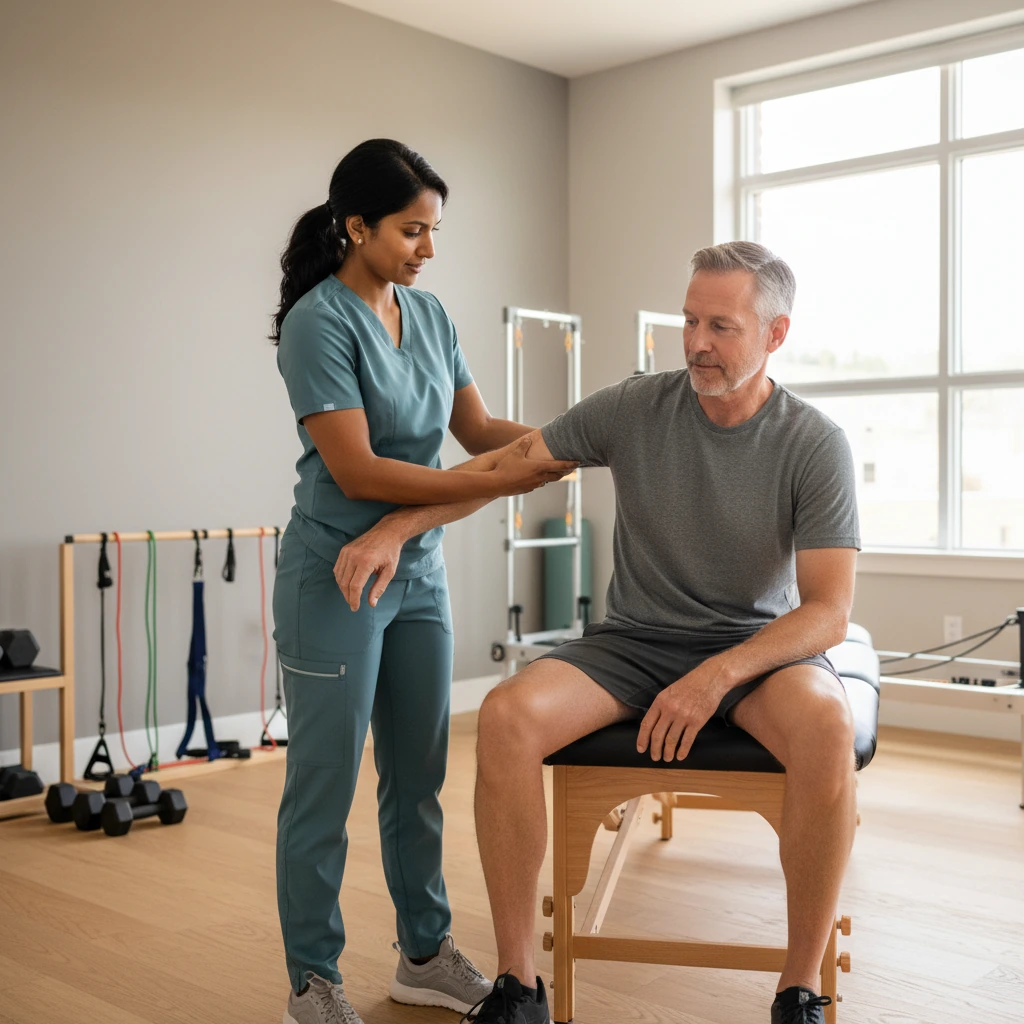
One Standard That Does Not Change Across All Six Locations: One-on-One, Licensed Therapist, Every Session
The most important thing a referring physician needs to know about Dynamic Physical Therapy is that every treatment session - not the initial evaluation, but every subsequent treatment session - is conducted entirely by the licensed therapist who evaluated your patient. Not a technician. Not a PT aide. Not a student doing their rotation. The therapist who established your patient's diagnosis is the therapist delivering their treatment.
This is not standard practice at most PT clinics in Queens and Long Island. In most multi-patient PT models, a therapist evaluates the patient, designs the program, and then supervises a caseload of patients spread across a shared gym - with aides and technicians doing the hands-on treatment. At Dynamic PT, that model does not exist. The clinical relationship between therapist and patient is direct, uninterrupted, and maintained for the full course of care.
What Your Patient Experiences - and What You Receive - at Each Stage
Every referred patient follows the same structured pathway. The left column describes what happens for your patient at each stage; the right column describes what it means for you as the referring physician.
Intake & Insurance Verification
Your patient contacts us by phone or we contact them after receiving your fax referral. Our intake team verifies their complete insurance benefits - co-pay, deductible, covered visits, and any prior authorisation or prescription requirement for their specific plan - before scheduling. They arrive for their first appointment knowing exactly what to expect financially. There is no surprise billing.
No Administrative Follow-Up Needed
We handle all intake coordination and insurance verification directly with your patient. Your staff do not need to follow up on referral status or insurance questions.
Complimentary Assessment (Optional) or Initial Evaluation
For patients who are uncertain about proceeding, we offer a free complimentary assessment - a full clinical evaluation with a licensed therapist, at no charge, that establishes the diagnosis and outlines the treatment plan before any financial commitment. For patients who are ready to proceed, the initial evaluation is a comprehensive assessment: a thorough history, objective testing, functional movement analysis, and diagnosis. A treatment plan is established and shared with the patient before the first treatment session begins.
Initial Evaluation Summary Transmitted
A written summary of assessment findings, the established PT diagnosis, and the proposed treatment plan is transmitted to your practice following the initial evaluation.
One-on-One Treatment - Every Session
Treatment at Dynamic PT is hands-on, individualised, and conducted entirely by the licensed therapist - not delegated to support staff. Depending on the diagnosis and treatment plan, sessions may include manual therapy techniques (joint mobilization, spinal manipulation, neural mobilization, myofascial release), individually prescribed therapeutic exercise, advanced modalities (laser therapy, cupping, Kinesio taping, dry needling), and targeted neuromuscular retraining.
No Aide or Technician Substitution
Your patient is treated by a licensed therapist at every session. The therapist who assessed them delivers all hands-on treatment and progresses the plan - not an aide, technician, or student.
Diagnostic Testing (When Clinically Indicated)
If assessment findings indicate that objective diagnostic testing is needed - EMG/NCS to confirm a suspected radiculopathy or MSKUS to characterise a tendon injury - that testing is performed in our clinic, by our clinical team, in the same visit. There is no separate referral to a neurology lab, no external imaging centre appointment, and no multi-week wait for results. The diagnostic finding is available within 48 hours and integrated promptly into the treatment plan.
Diagnostic Results Transmitted Within 48 Hours
EMG/NCS and MSKUS reports are transmitted to your practice within 48 hours of testing - not routed through a separate radiology or neurology practice.
Ongoing Progress & Plan Adjustment
Treatment plans are not static. Your patient's therapist reassesses functional status and treatment response at regular intervals and adjusts the plan accordingly - progressing exercise parameters, changing manual therapy techniques, adding or removing modalities, and modifying the home program. If a clinical finding during treatment warrants your awareness - an unexpected diagnostic result, a failure to progress as expected, a new symptom suggesting a different diagnosis - we contact your practice directly rather than waiting for the discharge summary.
Direct Contact for Clinical Concerns
If treatment findings or response warrant physician awareness, we contact you directly. You are not left to discover concerns at discharge.
Discharge Planning & Home Program
Discharge is planned - not abrupt. Your patient leaves with a structured home exercise program, clear functional goals for continued self-management, guidance on return to activity and sport where applicable, and specific instructions for symptoms that should prompt re-evaluation. The aim is for the gains achieved in the clinic to transfer permanently to your patient's daily life - not to create an ongoing dependency on treatment visits.
Discharge Summary Transmitted
A full discharge summary - final functional status, treatment outcomes, home program, and any recommendations for ongoing care or follow-up referrals - is transmitted to your practice.
The Standard PT Model vs. the Dynamic PT Model
Most physical therapy clinics operate a shared-care model where therapist time is spread across multiple patients simultaneously, with aides and technicians doing the hands-on work. This is not a criticism - it is a widespread economic reality of the PT business model. But it does have clinical consequences for your patients. Here is the practical difference.
Standard Multi-Patient PT Model
How most PT practices operate in high-volume clinic settings
Dynamic PT - One-on-One Model
The clinical standard at all six Dynamic PT locations
The Advanced Techniques Your Patients Receive
Physical therapy licensure establishes a minimum competency floor. Our therapists practise well above that floor - trained in advanced techniques that require post-graduate certification and ongoing clinical development to deliver safely and effectively.
Manual Therapy & Spinal Manipulation
Joint mobilization (Maitland Grades I - V), high-velocity low-amplitude spinal manipulation (HVLA), and neural mobilization - evidence-based hands-on techniques that produce neurophysiological pain relief and restore joint mobility beyond what exercise alone can achieve. HVLA manipulation is an ACP first-line recommendation for acute, subacute, and chronic spinal pain.
Myofascial Release & Soft Tissue Techniques
Myofascial release, trigger point therapy, instrument-assisted soft tissue mobilization, cupping, and dry needling - techniques targeting the connective tissue and muscle pathology that contributes to chronic pain, restricted mobility, and neuromuscular dysfunction. Applied by therapists with post-graduate certification in each modality.
Kinesio Taping & Bracing
Seven distinct Kinesio taping techniques calibrated to specific tissue targets - muscle facilitation and inhibition, fascial correction, lymphatic decompression, ligament support, and scar tissue correction. Applied with precision to tension percentage and direction by certified practitioners.
Therapeutic Exercise - FITT-VP Prescription
Exercise programs are individually prescribed using the FITT-VP framework (Frequency, Intensity, Time, Type, Volume, Progression) and the SAID principle - selecting the right exercise at the right dose for each tissue, healing stage, and functional goal. Programs are progressed systematically at every session based on objective assessment of tissue response.
Laser Therapy (Photobiomodulation)
FDA-cleared, drug-free photobiomodulation therapy - stimulating cellular repair through cytochrome c oxidase activation at the mitochondrial level. Reduces inflammation, modulates pain, and accelerates soft tissue and tendon healing in conditions including tendinopathy, nerve pain, and wound healing. Applied as an adjunct to manual therapy and exercise.
Vestibular Rehabilitation & Balance Retraining
Canalith repositioning manoeuvres (Epley, Semont, Barbecue Roll) for BPPV, vestibular adaptation and substitution exercises for unilateral hypofunction, gaze stabilisation training, and reactive balance drills for fall prevention and balance recovery.
Diagnostic Testing That Informs Treatment - in the Same Clinical Visit
The conventional diagnostic pathway separates testing from treatment by weeks. Your patient is assessed, a referral is generated, testing is scheduled at a separate facility, the report is transmitted back through the referral chain, and the treating therapist eventually adjusts the plan based on findings that may be weeks old by the time they land.
At Dynamic PT, this pathway does not exist. When a clinical question requires objective diagnostic confirmation, the test is performed in our clinic in the same visit - and the treatment plan is updated based on results returned within 48 hours. Four diagnostic modalities are available in-clinic across our locations.
EMG & Nerve Conduction Studies
Peripheral nerve and muscle function - radiculopathy, CTS, neuropathy, plexopathy, myopathy. Up to 50% of initial diagnoses change post-EMG/NCS. Full report within 48 hours.
Musculoskeletal Ultrasound (MSKUS)
Real-time dynamic imaging of tendons, muscles, bursae, and nerves. No radiation. Dynamic assessment of snapping, impingement, and instability invisible on static MRI. Results within 48 hours.
All diagnostic reports are transmitted to the referring physician within 48 hours of testing. No separate diagnostic facility referral is required. Results are available for your chart within 48 hours of your patient being tested. Full diagnostic services overview →
When You Hear From Us - and What You Receive
Physician communication at Dynamic PT follows a structured schedule tied to clinical milestones. You are not relying on your patient to relay information - you receive formal documentation at each stage.
Initial Evaluation Summary
Objective assessment findings, established PT diagnosis, functional limitations, short and long-term goals, and the proposed treatment plan. Transmitted to your practice following the first visit. For post-surgical patients, this includes confirmation that the operative report has been reviewed and that the treatment protocol is consistent with the surgical approach.
Diagnostic Study Reports
EMG/NCS and MSKUS reports are transmitted to your practice on the day of testing - including the quantitative data, the clinical interpretation, and any recommendations for the next step in care. Available for your chart immediately.
Progress Reports
Periodic updates on functional status changes, objective outcome measure scores, treatment response, and any adjustments to the plan. Frequency is adjusted based on case complexity and payer requirements - No-Fault and Workers' Compensation carriers typically require monthly progress notes, which are transmitted to both the carrier and the referring physician.
Direct Contact for Clinical Concerns
If a clinical finding during treatment warrants your attention - an unexpected diagnostic result suggesting a diagnosis requiring medical management, a significant failure to progress despite appropriate PT, a new symptom pattern suggesting a different aetiology, or a finding indicating urgent referral - we contact your practice directly. We do not file this information in the discharge summary and wait.
Discharge Summary
Final functional status and objective outcome measure scores at discharge versus intake, treatment outcomes achieved, the structured home exercise program, activity and return-to-sport guidance where applicable, and any recommendations for follow-up care - additional diagnostic work-up, specialist referral, or re-initiation of PT if symptoms recur. Transmitted to your practice on or before the final treatment date.
Common Questions from Referring Physicians
Do my patients need a prescription to begin physical therapy at Dynamic PT?
Under New York State's Direct Access provision, patients can begin physical therapy evaluation and treatment without a physician prescription for up to 30 days or 10 visits. However, most commercial insurance plans, Medicare, Medicaid, No-Fault carriers, and Workers' Compensation payers require a physician prescription for PT services to be covered under the patient's plan. We verify this with the patient's specific plan during insurance verification before their first appointment and advise accordingly - so neither you nor your patient is caught by a coverage surprise. When a prescription is required, a brief script with the diagnosis and referral for PT is sufficient.
What happens if the EMG/NCS or other diagnostic testing reveals a finding that changes the clinical picture significantly?
If diagnostic findings significantly change the clinical picture - for example, if EMG/NCS reveals severe axonal loss suggesting urgent surgical consideration, or if MSKUS demonstrates a full-thickness rotator cuff tear in a patient being treated conservatively - we contact your practice directly the same day to discuss the findings. The diagnostic report is transmitted simultaneously. For cases where the finding suggests a need for urgent escalation, we call before the written report arrives. We do not sit on clinically significant findings.
How do you handle post-surgical patients? Can I refer immediately post-operatively?
Yes - and we prefer early referral for post-surgical cases where the operative protocol supports it. Before initiating treatment for any post-surgical patient, we obtain and review the operative report and confirm protocol specifics - weight-bearing status, ROM restrictions, precautions, and the surgeon's specific rehabilitation protocol - directly with your office. For procedures with well-established published protocols (ACL reconstruction, rotator cuff repair, total knee and hip arthroplasty, lumbar discectomy), we follow the protocol as written. For any procedure where the surgeon has specific deviations from standard protocol, we confirm those in writing before the first treatment session. You will receive an initial evaluation summary confirming that we have reviewed the operative report and are following the correct protocol.
What is your approach to patients with concurrent medical complexity - cardiac conditions, anticoagulation, active cancer, or frailty?
We contact the referring physician directly before initiating treatment for patients with significant medical complexity - particularly cardiac conditions with exercise restrictions, patients on anticoagulants (relevant for dry needling and certain manual therapy techniques), active oncology patients, and patients with significant frailty or multi-morbidity. Dr. Soni's GCS (Geriatric Clinical Specialist) designation reflects specific advanced training in managing older adults with complex medical backgrounds. For these patients, we treat the physician's guidance on precautions and restrictions as the clinical boundary within which we design the PT program - not as an obstacle to overcome.
Which insurance plans do you accept, and how do you handle No-Fault and Workers' Compensation?
We accept Medicare, Medicaid, No-Fault (all major carriers), Workers' Compensation, and most commercial insurance plans including United Healthcare, Aetna, Cigna, Blue Cross Blue Shield, and Emblem Health. For No-Fault cases, we handle all carrier coordination - NF-3 authorisations, peer review responses, and monthly progress note submissions. For Workers' Compensation cases, we manage the prior authorisation process and all required documentation. Your patient does not need to navigate the carrier relationship - we do. We verify complete benefits before every first appointment and advise your patient on any out-of-pocket liability before they arrive.
Questions About a Specific Patient or Case?
Call our clinical team directly. We are available to discuss specific cases, confirm appropriate diagnostic studies, or coordinate care before you refer.