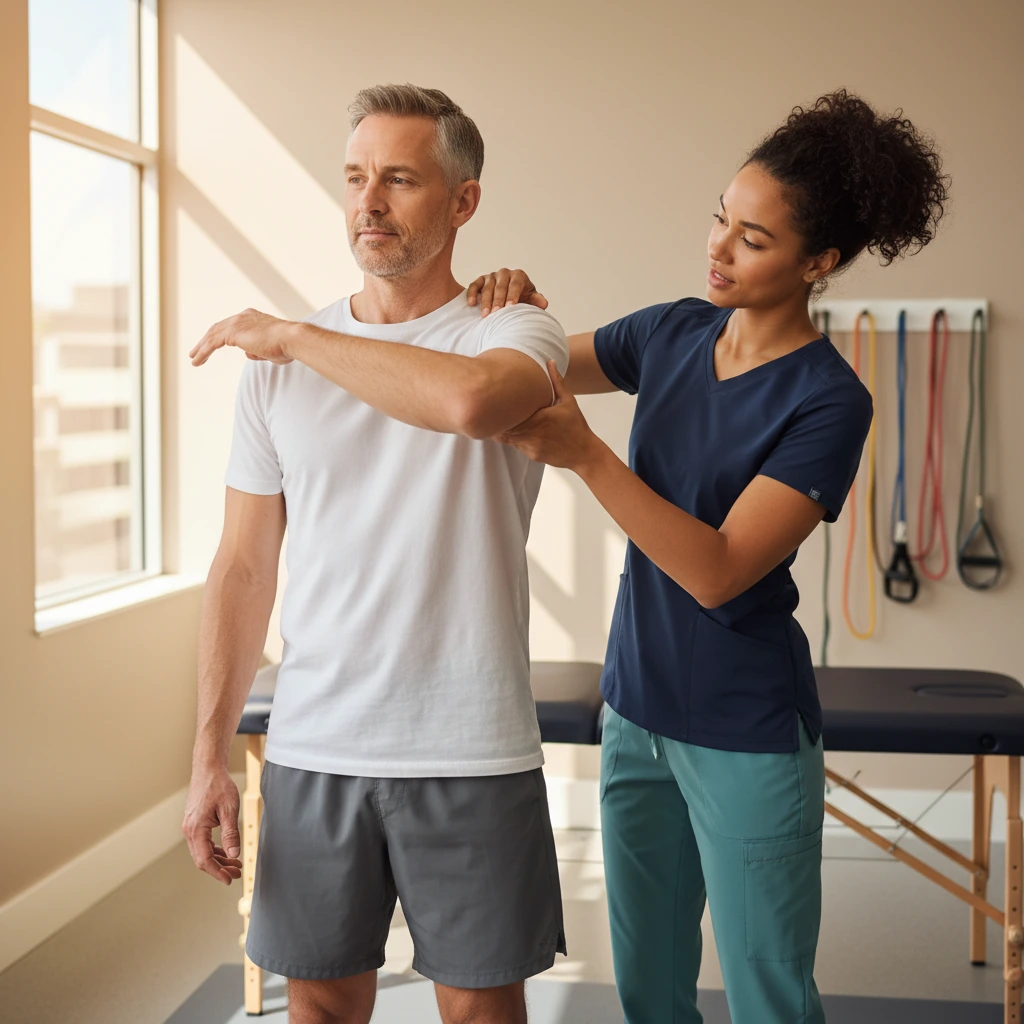
Proprioception Therapy & Neuromuscular Retraining in Queens & Long Island
Your Joints Know Where They Are - Until Injury, Surgery, or Aging Disrupts That Signal
Proprioception is your body's internal GPS - the continuous, unconscious stream of sensory information from muscles, tendons, joints, and skin that tells your brain where every part of your body is in space, how fast it's moving, and how much force it's producing. You don't think about it when you walk on uneven ground, catch your balance, or reach for something without looking. It just works - until it doesn't.
Every significant joint injury, surgical procedure, and neurological condition disrupts proprioception. Ligament tears damage the mechanoreceptors embedded in joint tissue. Surgical incisions interrupt afferent nerve pathways. Ageing progressively reduces muscle spindle sensitivity and joint receptor density. The result is a subtle but functionally significant deficit in joint position sense, reaction time, and neuromuscular control - that conventional strengthening and stretching alone will not correct. At Dynamic Physical Therapy, proprioception retraining is a systematic, progressive component of every rehabilitation program where joint stability and movement control have been compromised - because restoring strength without restoring neuromuscular control leaves the joint vulnerable to re-injury.
What Proprioception Is - and the Sensory Receptors That Provide It
Proprioception encompasses two distinct but related senses: joint position sense (the ability to know where a joint is positioned in space without looking at it) and kinesthesia (the ability to detect the direction and speed of joint movement). Both are generated by mechanoreceptors - specialised sensory receptors distributed throughout the musculoskeletal system that convert mechanical deformation into neural signals sent to the brain and spinal cord.
These signals operate at three levels of motor control simultaneously - the spinal cord level (producing reflexive protective muscle contractions before conscious awareness), the brainstem level (coordinating posture and balance automatically), and the cortical level (enabling conscious joint position awareness and skilled voluntary movement). Proprioceptive training targets all three levels through progressively challenging exercises that force the nervous system to refine and accelerate its sensorimotor processing.
Muscle Spindles
Specialised sensory organs within muscle that detect changes in muscle length and the rate of length change - providing the primary signal for limb position and movement speed. Muscle spindle sensitivity is enhanced by training and diminished by injury, disuse, and ageing.
Golgi Tendon Organs
Sensory receptors at the muscle-tendon junction that detect tension levels - providing protective inhibitory signals when force exceeds safe limits, and contributing to the sense of effort and force during movement. Essential to controlled, graduated force production.
Joint Mechanoreceptors
Ruffini endings, Pacinian corpuscles, and free nerve endings distributed throughout joint capsules and ligaments - detecting compression, tension, and movement at joint surfaces. Ligament tears directly destroy these receptors, creating the proprioceptive deficit that persists long after the structural repair heals.
Cutaneous Mechanoreceptors
Sensory receptors in the skin and plantar surface of the foot - providing critical supplementary proprioceptive information, particularly during weight-bearing activities. Their contribution to balance and gait is why footwear, plantar sensation loss (in diabetic neuropathy), and foot position all significantly affect postural stability.
How Impaired Proprioception Shows Up in Daily Life and Sport
Proprioceptive deficits are rarely obvious in simple, slow, familiar movements. They reveal themselves under challenge - at speed, on uneven surfaces, in the dark, under fatigue, or in the reactive split-second demands of sport and real-world activity.
When Proprioception Needs to Be Specifically Addressed in Rehabilitation
ACL Tear & Knee Reconstruction
Ankle Sprains & Chronic Instability
Total Knee & Hip Replacement
Shoulder Dislocation & Instability
Stroke & Neurological Conditions
Parkinson's Disease & Fall Risk
Peripheral Neuropathy
Osteoarthritis (Knee, Hip, Ankle)
Lumbar & Cervical Spine Instability
Sports Return-to-Play Rehabilitation
Vestibular & Balance Disorders
Age-Related Fall Prevention
How Proprioception Retraining Advances - From Static to Reactive
Proprioceptive retraining is not a single exercise - it is a structured progression through increasingly demanding challenges to the sensorimotor system. Advancing too quickly risks re-injury; progressing too slowly delays recovery. The progression is individualised to each patient's current functional level.
Stable Surface, Eyes Open
The entry point for all proprioceptive retraining - establishing the baseline neuromuscular control of a joint in the simplest, most controlled environment. Static holds on firm surfaces with eyes open allow the nervous system to re-establish accurate afferent signalling from the recovering joint before any challenge is added.
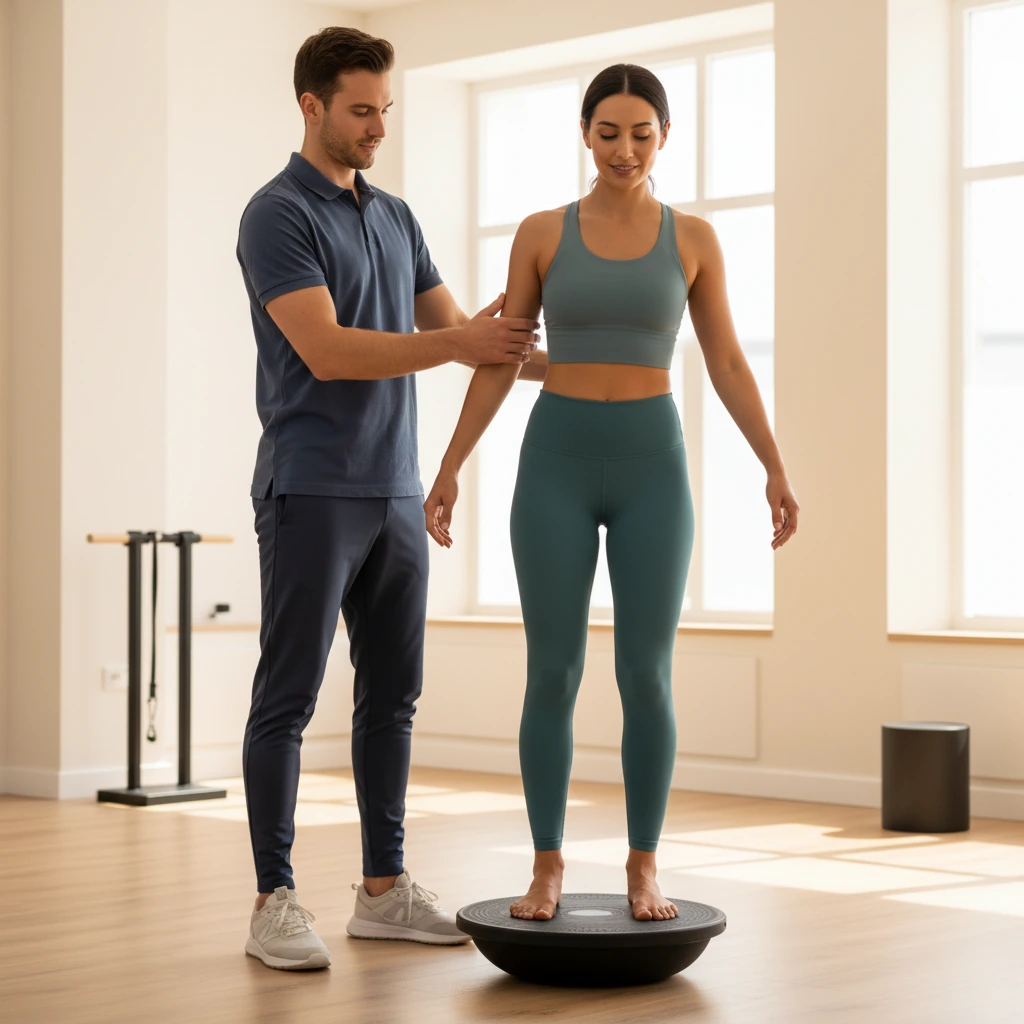
Stable Surface, Eyes Closed
Removing visual input forces the nervous system to rely exclusively on proprioceptive and vestibular input - dramatically increasing the demand on the proprioceptive system and revealing deficits that aren't apparent when vision compensates. Eyes-closed training specifically develops the proprioceptive channel rather than allowing visual dominance to persist.
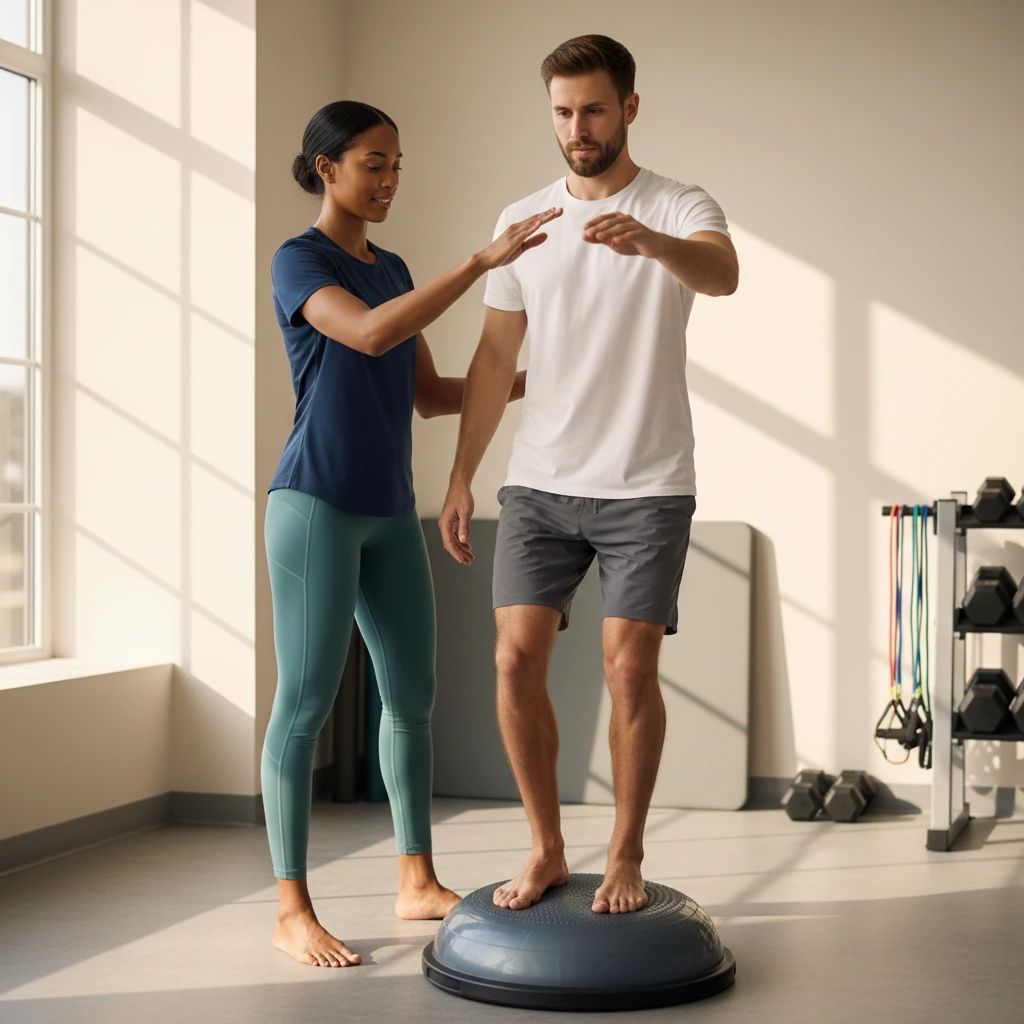
Unstable Surface Training
Foam pads, balance boards, wobble boards, and stability discs increase the sensory challenge by reducing the predictability and stability of the support surface - forcing the mechanoreceptors to work harder and faster to generate the postural correction signals that maintain balance. Unstable surface training is among the most effective proprioceptive training methods in the literature.
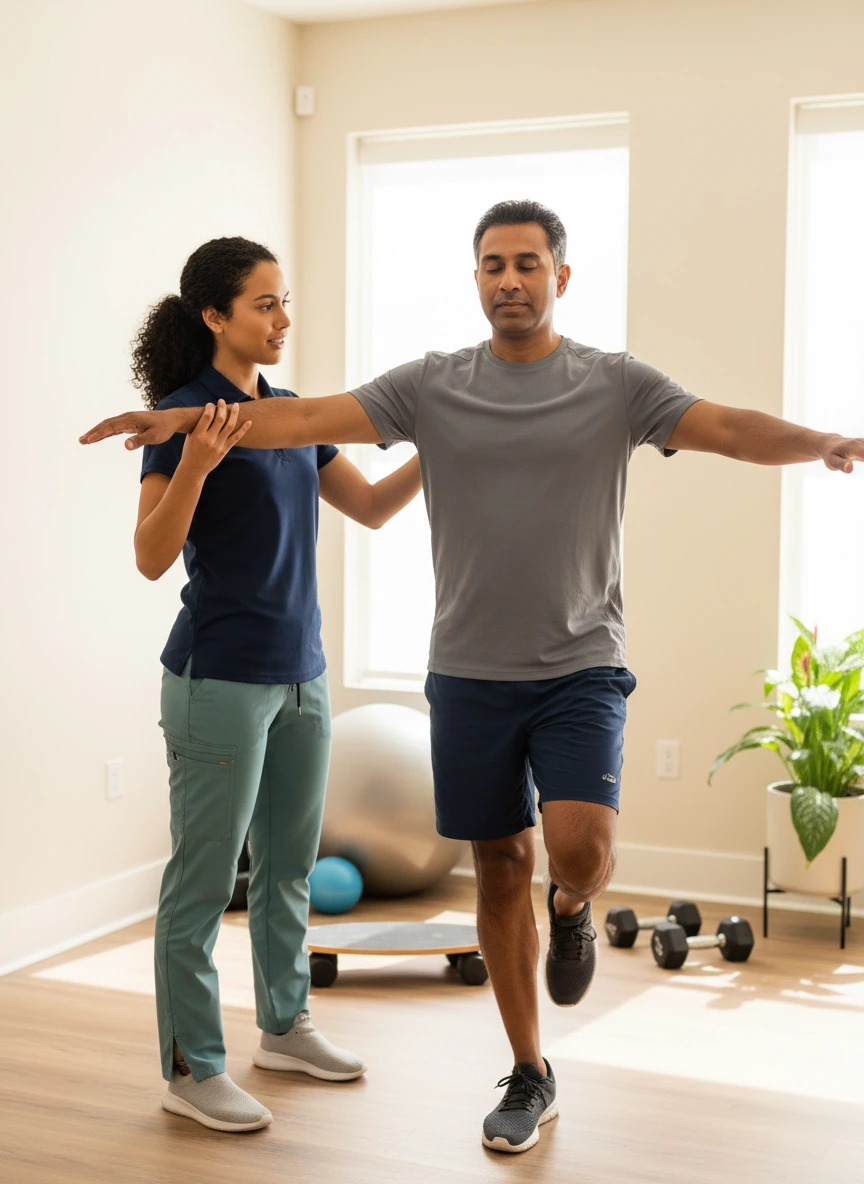
Moving Balance Challenges
Progressing from static holds to dynamic movement - stepping, reaching, catching, and multi-directional tasks - trains proprioception during the conditions where it matters most. Dynamic challenges demand continuous real-time sensorimotor adjustment, developing the kinesthetic processing speed that protects joints during activity.
Perturbation & Reactive Stabilisation
The highest level of proprioceptive training - introducing unexpected perturbations (sudden platform tilts, directional challenges, external forces) that demand the rapid, reflexive stabilisation responses that protect joints in real-world situations. Reactive training specifically develops the spinal reflex arc response speed that determines whether a joint is protected in the fraction of a second between perturbation and conscious awareness.
How We Assess and Retrain Proprioception at Dynamic PT
Proprioceptive retraining requires systematic assessment before programming - because the nature of the deficit (which joint, which level of motor control, which sensory channel) determines which exercises are most appropriate.
Proprioceptive Assessment
Clinical assessment of proprioceptive function includes the Romberg test (static balance with and without visual input), joint position sense testing (passive repositioning tasks with eyes closed), single-leg stance timed tests, functional movement screening, and assessment of the balance strategy used - ankle vs. hip vs. stepping - to identify the level and nature of the deficit before training begins.
Balance Board & Unstable Surface Training
Wobble boards, balance boards, foam pads, and rocker boards systematically challenge the mechanoreceptors of the ankle, knee, and hip to generate faster, more accurate postural correction signals - progressively increasing the instability challenge as performance improves across the five-level progression hierarchy.
Visual Deprivation Training
Systematic training with eyes closed - removing the visual compensation that allows patients to maintain balance despite proprioceptive deficits. Eyes-closed progressions force development of the proprioceptive channel specifically, building the sensory capacity needed for real-world performance in low-light, distracted, or high-speed conditions.
Perturbation Training
Therapist-applied unexpected perturbations during stance or movement - developing the reflexive stabilisation responses that protect joints from injury. The unexpected nature of the challenge is essential: it specifically trains the reflex arc response that occurs in the 40 - 100 milliseconds before conscious awareness, which is where the critical protective response must occur.
Sport-Specific Reactive Drills
For athletes, late-stage proprioceptive training progresses into sport-specific movement patterns under reactive conditions - cutting, jumping, landing, directional changes, and ball-tracking tasks that replicate the sensorimotor demands of the sport and confirm that neuromuscular control is adequate for safe return to full participation.
BlazePod Cognitive-Motor Integration
For patients where proprioceptive retraining needs to be combined with cognitive challenge - particularly neurological patients, fall-risk older adults, and athletes preparing for return to play - BlazePod reactive light drills integrate balance and proprioceptive challenges with simultaneous visual processing, reaction timing, and movement decision-making. Learn more about BlazePod training →
What to Expect from Proprioception Retraining at Dynamic PT
Baseline Proprioceptive Assessment
Your therapist assesses your proprioceptive function across the affected joint - using joint position sense testing, timed balance tasks, Romberg assessment, and functional movement analysis to identify which level of the progression hierarchy you are currently at and where the primary deficit lies.
Integration into Your Rehab Program
Proprioception retraining is not a standalone session - it is systematically integrated into your regular PT appointments alongside strengthening, manual therapy, and other indicated interventions. The intensity and complexity is calibrated to your current stage of healing, ensuring the joint is ready for each progression level before advancing.
Structured Progression
You advance through the five-level hierarchy as your performance at each level demonstrates readiness - from static stable surface through eyes-closed training, unstable surfaces, dynamic movement, and reactive perturbation tasks. Advancement is based on objective performance criteria, not time-based progression.
Home Program for Consistent Practice
Proprioceptive retraining requires consistent repetition to build the neural pathways that underlie improved joint position sense and reflex speed. You receive a specific home program at each stage - safely performable without supervision - that maintains and builds on in-clinic progress between sessions.
Function & Return-to-Activity Testing
At the end of your program, your proprioceptive function is reassessed against baseline - documenting your improvements in joint position sense, balance, and dynamic stability. For athletes, sport-specific functional testing confirms neuromuscular readiness for return to full training and competition.
What You Gain - and What You Risk Without It
Reduce Re-Injury Risk
The majority of repeat ankle sprains, ACL tears, and joint re-injuries occur not from inadequate strength but from delayed proprioceptive response - the reflex protection that should fire in 40 - 100ms didn't arrive in time. Systematic retraining directly addresses this.
Prevent Falls
For older adults, proprioceptive training is one of the most robustly evidence-supported fall prevention interventions - improving dynamic balance and postural reaction speed in ways that general exercise and strengthening do not specifically achieve.
Restore Athletic Confidence
Athletes who have recovered strength and range of motion but "don't feel right" or lack confidence in a previously injured limb typically have a residual proprioceptive deficit. Targeted retraining restores not just function but the neuromuscular confidence that reactive sport demands.
Faster, More Complete Recovery
Rehabilitation programs that include proprioceptive retraining consistently produce faster return to function and lower re-injury rates than strengthening programs alone - across ankle, knee, shoulder, and spine conditions in both the research literature and clinical practice.
Proprioception Therapy FAQs
Why does proprioception get damaged after a joint injury?
Joint ligaments and capsule tissue contain dense populations of mechanoreceptors - the sensory receptors that generate proprioceptive signals. When ligaments are torn or joint capsule is damaged, these mechanoreceptors are physically destroyed along with the structural tissue. Even after ligament healing, the mechanoreceptor population in the repaired tissue is reduced and the neural pathways that carried their signals may be altered. This is why proprioceptive deficits persist long after structural healing is complete - the structural repair doesn't restore the sensory function. This is also why proprioceptive retraining must be a specific, systematic component of rehabilitation rather than an assumed consequence of returning to activity.
Is proprioceptive training the same as balance training?
Balance training and proprioceptive training significantly overlap, but are not identical. Balance is the outcome - the ability to maintain equilibrium. Proprioception is one of three sensory inputs that contribute to balance (alongside vision and the vestibular system). Proprioceptive training specifically targets the mechanoreceptor-based sensory channel through exercises that systematically challenge joint position sense, remove visual compensation, and increase surface instability demands. Balance training may address all three systems simultaneously, or weight the vestibular component more heavily. At Dynamic PT, we assess which system is the primary deficit and weight the training accordingly - rather than applying a generic balance program that may not target the specific sensory channel that's been compromised.
How long does it take to restore proprioception after an injury?
For acute injuries in otherwise healthy individuals, meaningful proprioceptive recovery typically occurs over 6 - 12 weeks of systematic training - with measurable improvement in joint position sense and single-leg balance visible within the first 3 - 4 weeks. For post-surgical cases, the timeline depends on the specific procedure and healing constraints, but proprioceptive retraining is introduced progressively from the early stages of rehabilitation and continues through the full return-to-activity phase. For neurological conditions and age-related decline, proprioceptive training is an ongoing management strategy rather than a time-limited course - producing continued improvement with sustained training.
Can proprioception training prevent re-injury?
Yes - the evidence is strong and consistent across multiple injury types. For ankle sprains, proprioceptive training programs reduce re-sprain rates by 40 - 50% compared to standard rehabilitation. For ACL reconstruction, programs that include neuromuscular and proprioceptive training produce significantly lower re-tear rates than strength-focused programs alone. For older adults, proprioceptive balance training reduces fall frequency by 20 - 35% in high-quality randomised controlled trials. The mechanism is the same across all these contexts: restoring the reflex arc response speed and joint position sense accuracy that provides the split-second protective response before conscious awareness.
Is proprioception retraining covered by insurance?
Proprioceptive training delivered as part of a physical therapy plan of care is covered by Medicare, Medicaid, and most commercial insurance plans - billed as neuromuscular re-education and therapeutic exercise, both of which are standard PT CPT codes. At Dynamic Physical Therapy, we verify your complete benefits before your first appointment. Call (516) 661-9880 and our team will confirm your coverage in advance.